Adrienne Rich's poem 'The Trees' symbolizes the struggle for freedom and identity, using the imagery of trees breaking free from confinement to represent oppressed individuals, particularly women. The poem employs literary devices such as symbolism, simile, and visual imagery to convey its themes, ultimately highlighting the hope for liberation and the challenges faced in achieving it.
Adrienne Rich was an influential American poet, essayist, scholar, teacher, feminist, and critic. Born in Baltimore, Maryland, her literary career began with the publication of her first poetry collection, A Change of World, in 1951. Rich's body of work includes notable publications such as Snapshots of a Daughter-in-Law, Diving into the Wreck, and An Atlas of the Difficult World. Her poetry is renowned for its strong feminist perspectives and its exploration of identity, justice, war, and violence, particularly concerning women's roles in society. Additionally, her essays often delve into women's experiences within family and societal structures, with her work Of Woman Born: Motherhood as Experience and Institution being regarded as a landmark text in feminist literature.
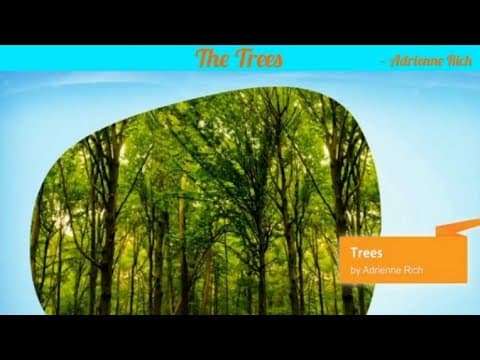
In her poem The Trees, Rich uses the imagery of trees breaking free from their anchors to symbolize the desire for freedom from oppressive systems. The poem begins with the trees moving back to the forests, a place where they can thrive. Before this movement, the forests were devoid of trees, leaving birds without perches and insects without hiding places. Rich paints a hopeful picture as she imagines the forests filling with trees by morning, representing an oppressed woman's yearning for liberation.
Rich's use of trees as symbols is central to the poem's meaning. The trees represent the struggle for freedom, paralleling the experiences of individuals, particularly women, who seek to break free from societal constraints. The poem describes how roots attempt to escape the cracks of the veranda floor, while leaves and branches, confined within the house, strive to break through the glass of the window. This imagery evokes the confusion and struggle of patients being released from a hospital, emphasizing the difficulty of breaking free from long-established constraints.
Rich introduces herself into the poem through the use of the word "I." She describes sitting inside her house, writing a letter, yet she chooses not to focus on the extraordinary event of the trees moving around her. Instead, she reflects on the scent left behind by the trees, likening it to a voice that lingers in the room after someone has spoken. This decision to remain silent about the event underscores the significance of the moment.
As Rich continues, she expresses that her mind is filled with the whispers of sounds left by the trees. She invites the reader to listen to the sound of glass breaking as the trees escape their confinement and move into the open night. The wind welcomes them, but Rich's view of the full moon is obstructed by the trees, which break the moon's light into shards, resembling a broken mirror.
Rich employs various literary devices to enhance the poem's themes:
Adrienne Rich's The Trees serves as a powerful metaphor for the quest for freedom and identity. Through her vivid imagery and thoughtful symbolism, Rich captures the essence of liberation, the challenges faced in achieving it, and the hope that accompanies the journey. The poem resonates with anyone who has ever felt confined by societal expectations and yearned for the freedom to return to their true selves.