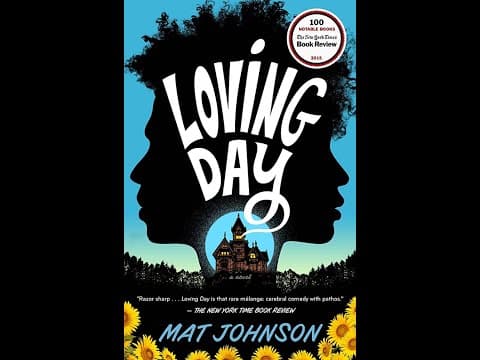
Mat Johnson's novel 'Loving Day' intricately weaves themes of racial identity, love, and personal growth through the story of Warren Duffy, a biracial man navigating his complex heritage and unexpected fatherhood, all while confronting societal norms and personal failures.
Mat Johnson's 2015 novel, Loving Day, draws its title from the landmark Supreme Court case Loving v. Virginia, which legalized interracial marriage in the United States in 1967. With a satirical and humorous tone, the book delves into complex questions surrounding racial identities in contemporary America while also exploring themes of love, including self-love.
The story is narrated in the first person by Warren Duffy, a conflicted and self-deprecating character. Despite being in his 30s, Warren perceives himself as a resolute failure, having already experienced a failed marriage and career. Born to a black mother and an Irish-American father in Philadelphia, Warren's fair skin creates a sense of inadequacy as he grapples with his identity as a black man shaped by America's historical construction of race.
After his parents' divorce, Warren grew up in Germantown, one of the impoverished African-American neighborhoods in Philadelphia. Following his mother's passing, he pursued his dream of becoming a comic book illustrator by studying in Wales. However, success eluded him, and he ended up marrying a Welsh woman and opening a comic book shop.
At the start of Loving Day, Warren has recently endured a hostile and costly divorce, and his comic book shop has failed. When his estranged father passes away, Warren inherits an 18th-century mansion on seven acres of land in Germantown. Returning to his hometown, he hopes to improve his dire financial situation through a lucrative real estate deal. However, his expectations are shattered upon seeing the dilapidated state of the estate, surrounded by what Warren refers to as the Germantown ghetto.
Faced with the mansion's disrepair, Warren contemplates burning it down to collect insurance money as his only viable option. Soon, he discovers that the mansion is haunted by apparitions. On his first night in the house, he glimpses two figures on the front lawn through a window, sparking intrigue and mystery.
Warren's life takes a drastic turn at a local comic book convention, where he is assigned to an urban panel alongside three other black men. Despite his protests that his book is set in the rural South, Warren attempts to compensate for his fair skin by adopting what he deems a black voice when conversing with the panelists. However, his efforts to strengthen his black identity lead to unintended consequences.
During his presentation, a woman in the audience challenges him to address his experiences as a biracial artist. Warren dismisses the question, asserting that American society only recognizes black and white identities, leaving no room for biracial individuals. The woman accuses him of denying his mixed heritage, which adds to his internal conflict.
Unexpectedly, Warren learns that he has a daughter named Tao, the result of a brief romance with a Jewish girl during his teenage years. Tao's mother has passed away, leaving her in the care of her grandfather, Irv, who insists that Warren take responsibility for his 17-year-old daughter. Tao moves into Warren's mansion, settling into a tent in the drafty front room.
Growing up in a Jewish family, Tao is taken aback when Warren informs her that, despite her appearance, she is no longer considered white. He explains that due to America's persistent adherence to the historical one-drop rule, which designates minority status to individuals with any African ancestry, he views both himself and his daughter as black. However, Tao does not readily accept this revelation, leading Warren to label her as casually racist.
Warren's next responsibility as a new father is to ensure that Tao completes high school. The Mail on Center for Multiracial Life, a private school aiming to bridge the racial divide between black and white, becomes a potential option. Set up in trailers unlawfully placed in a city park, the unconventional structure of the school reflects its anti-establishment ideals.
Warren is offered a teaching position at the school, specializing in illustration, but must undergo a peculiar test that includes questions like "What are your feelings about mayonnaise?" and "Was O.J. Simpson guilty?" Although Warren strongly identifies as black, he remains skeptical about the school's approach. In contrast, Tao is enamored with the school, which Warren lovingly nicknames Milotopia.
Warren finds himself irresistibly drawn to Sunita Habersham, an outspoken biracial woman he encountered at the comic convention, who is now a teacher at the Mail on Center. Despite his continued fantasies of setting his mansion ablaze, the Mail on Center relocates to his property after being evicted from the park, forcing him to adjust his arson daydreams accordingly.
Warren embarks on an affair with Sunita and forms friendships with other members of the Melange community. Rosalind Kornbliff, the founder of Melange, expresses interest in purchasing Warren's estate, leading to negotiations over the selling price. However, Warren's childhood friend and former crush, Tosha, disapproves of his association with the Melange Center and his apparent attraction to its multiracial rhetoric.
The ghostly couple Warren glimpsed when he first moved into the mansion continues to make occasional appearances. Tao conducts a séance, and the ethereal man and woman manifest outside the bathroom window, appearing to float as they engage in intimate acts. The Melange community rejoices at witnessing this unequivocally interracial union, affectionately referring to the spirits as the first couple.
Tao decides to upload a video of the spectral lovemaking to YouTube, which quickly goes viral, bringing widespread attention to Melange and its upcoming festival on June 12th. The center organizes a Loving Day Festival to commemorate the landmark Supreme Court decision in 1967. Protesters line the streets expressing their dissent while Melange students stage a miscegenation pageant aiming to challenge societal norms.
As Warren covertly arranges propane tanks as part of his plan to rid himself of the mansion and the Melatopians, his arson plot takes an unexpected turn when his car accidentally explodes. Instead of the mansion, Warren finds himself imprisoned for burning without a permit. Upon his release, he returns home only to discover that the mansion is no longer there. Tao reveals that she sold the property to the Melange community, which has relocated it to Maine.
As Warren contemplates his next move, the ghostly couple reappears on the lawn, prompting him to reach a final realization: he acknowledges, "I see what they are or what they were just lovers, just people."
Mat Johnson, the author of Loving Day, identifies himself as the light-skinned product of an interracial marriage and describes the novel as his personal journey of embracing his multiracial identity. The book received the prestigious 2016 American Book Award, highlighting its significance in contemporary literature. Through Warren's journey, Loving Day invites readers to reflect on the complexities of identity, love, and the societal constructs that shape our understanding of race.