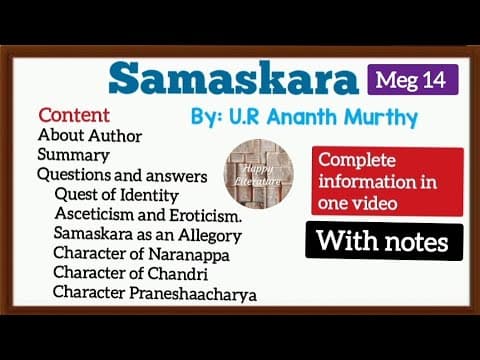
This blog post provides a comprehensive summary of U.R. Ananth Murthy's novel 'Samaskara', focusing on its central themes of identity, societal norms, and the complexities of rituals surrounding death, particularly through the character of Narayanappa and his relationships with Chandra and Pranesh Acharya.
U.R. Ananth Murthy, a prominent Indian contemporary writer and critic, is known for his significant contributions to Kannada literature. His novel "Samaskara" has garnered critical acclaim and has been translated into English, allowing a wider audience to engage with its profound themes. The novel explores complex issues surrounding identity, societal norms, and the rituals associated with death, particularly within the Brahmin community in Karnataka.
Ananth Murthy has received numerous accolades for his literary work, including the prestigious Jananpith Award, India's highest literary honor, and the Padma Bhushan in 1998. He has also served as the Vice-Chancellor of Mahatma Gandhi University in Kerala and was a finalist for the Man Booker International Prize.
The central narrative of "Samaskara" revolves around the death of Narayanappa, a Brahmin who defies traditional norms. The story is set in a small village called Durvasa Pur, predominantly inhabited by the Madhava Brahmin community. Narayanappa's life and death raise critical questions about identity and the societal expectations surrounding rituals, particularly the last rites.
Narayanappa: The protagonist, Narayanappa, is portrayed as an anti-Brahminical Brahmin. He disregards the community's norms, indulging in non-vegetarian food, alcohol, and cohabiting with a low-caste prostitute named Chandra. His lifestyle leads to conflict with the local Brahmin community, who are outraged by his actions.
Chandra: Chandra, the prostitute, becomes a pivotal character in the narrative. After Narayanappa's death, she is left to navigate the complexities of performing his last rites, as the community refuses to acknowledge him due to his non-conformity.
Pranesh Acharya: A Vedic scholar and spiritual leader of the Brahmin community, Pranesh Acharya is approached by Chandra and the villagers for guidance on how to conduct Narayanappa's last rites. His character embodies the struggle between tradition and personal beliefs.
The quest for identity is a recurring theme in "Samaskara". Narayanappa's life challenges the rigid caste system and societal expectations. His refusal to conform raises questions about what it means to belong to a community and the implications of one's choices on their identity.
The novel highlights the significance of rituals, particularly the last rites, in Brahmin culture. The confusion surrounding Narayanappa's funeral reflects the community's struggle to reconcile their beliefs with his unconventional life. The narrative delves into the meaning of societal work, emphasizing the importance of last rites in the context of death.
Chandra's character serves as a critique of the societal position of women within the caste system. Despite being marginalized, she exhibits strength and agency, challenging the perceptions of her identity and desires. The author uses her character to explore the complexities of gender and societal expectations.
U.R. Ananth Murthy's "Samaskara" is a profound exploration of identity, societal norms, and the rituals surrounding death. Through the characters of Narayanappa, Chandra, and Pranesh Acharya, the novel invites readers to reflect on the complexities of human desires and the societal structures that shape our identities. The narrative serves as a powerful commentary on the intersections of caste, gender, and personal beliefs, making it a significant work in contemporary Indian literature.