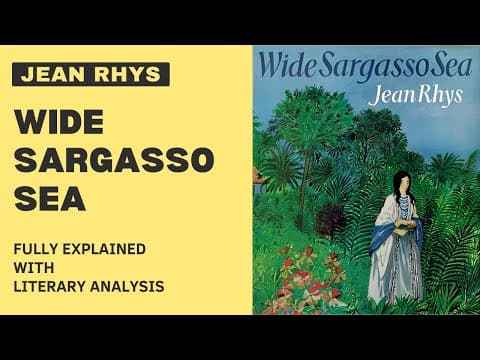
Wide Sargasso Sea by Jean Rhys serves as a prequel to Jane Eyre, giving voice to Bertha Mason and exploring themes of colonialism, racial inequality, and madness through the lens of Antoinette Causeway's tragic story. Rhys' own life experiences deeply inform the narrative, making it a significant work in post-colonial and feminist literature.
Wide Sargasso Sea, a novel by Jean Rhys published in 1966, has captivated readers for decades with its riveting narrative and complex characters. Rhys, an accomplished writer born in Dominica to a Creole mother and a Welsh father, draws heavily from her background to inform her writing. This novel serves as a prequel to Charlotte Brontë's Jane Eyre, giving voice to Bertha Mason, often dismissed as the madwoman in the attic. Through Rhys' narrative, Bertha comes alive, offering readers a fresh perspective on a character previously left in the shadows.
The story unfolds in the lush tropical backdrop of 19th century Jamaica and is divided into three parts, each narrated from a different perspective.
In the first part, we meet Antoinette Causeway, a Creole heiress living in Jamaica. Her tale begins with themes of isolation and the racial tensions surrounding her. Growing up in a society that despises her mixed heritage, Antoinette faces rejection from her own mother after a traumatic fire destroys their home. This sets the stage for her eventual descent into madness.
The narrative shifts to Antoinette's husband, Mr. Rochester, an Englishman who marries her for her wealth. However, he is repulsed by the foreignness of both Antoinette and the Caribbean. His cruel treatment exacerbates her already fragile mental state, leading her deeper into madness.
In the final part, Antoinette is now in England, locked away in the attic of Thornfield Hall. Here, we witness her deteriorating mind, her dreams of revenge, and her final act of setting the mansion on fire. This tragic conclusion encapsulates the themes of identity and madness that permeate the novel.
Wide Sargasso Sea explores the damaging effects of colonialism and racial prejudice, illustrating how these forces can lead to the disintegration of identity and sanity.
Antoinette's tragic descent into insanity is portrayed as a result of societal rejection and marital abuse, highlighting the psychological impact of her circumstances.
The novel presents Antoinette as a complex character struggling against the constraints of a patriarchal society. Rhys challenges the traditional portrayal of women in literature, adding depth and complexity to the female narrative.
Wide Sargasso Sea takes readers on a journey through colonial Caribbean society, painting a vivid picture of the post-emancipation era. It delves into the cultural and racial tensions of the time, offering a unique perspective on the struggles of the Creole population. The narrative critiques Victorian England's rigid class structure and moral codes through Rochester's character, who cannot reconcile his English views with Caribbean culture.
As a prominent post-colonial novel, it challenges Eurocentric narratives, giving voice to the colonized, particularly Antoinette, who was previously silenced in Jane Eyre. This rewriting of history from the perspective of the oppressed is a powerful tool in post-colonial literature.
Jean Rhys' life experiences significantly influenced Wide Sargasso Sea. Born in Dominica, her Creole heritage—a fusion of European, African, and Caribbean influences—is reflected in the novel's rich tapestry of characters and settings. Like Antoinette, Rhys experienced cultural displacement and alienation, never fully accepted by either European society or the native Caribbean populace.
Her upbringing amidst stark social inequalities is vividly depicted in the novel's setting, contrasting the idyllic natural landscape with the human tensions brewing beneath. Rhys' move to England at 16 further deepened her sense of alienation, mirroring Antoinette's experiences in the novel.
Wide Sargasso Sea continues to resonate with readers, its themes of identity, displacement, and otherness as relevant today as they were when first published. This enduring relevance, coupled with its literary merit, cements its position as a cornerstone of 20th-century literature. Through our exploration of the complex plot, intricate characters, and major themes, we gain a greater appreciation for Jean Rhys' masterpiece and its profound impact on literature.