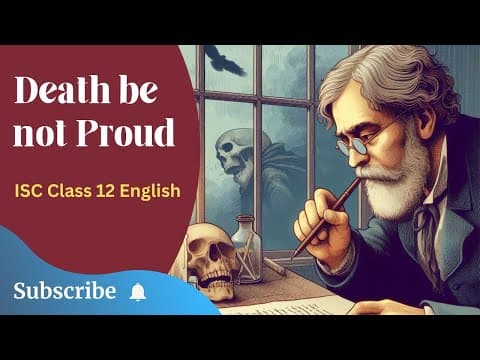
John Donne's sonnet 'Death Be Not Proud' challenges the power of death, presenting it as a mere inconvenience rather than a finality. Through personification and metaphysical themes, Donne argues for the immortality of the soul and the transient nature of death, ultimately portraying it as a temporary state leading to eternal awakening.
John Donne's sonnet "Death Be Not Proud" is a profound exploration of the complex theme of death. Written in 1609 and published in 1633, this 14-line poem is part of Donne's collection of holy sonnets and is characterized by its metaphysical style, which delves into abstract themes and human emotions. In this blog post, we will analyze the poem's themes, structure, and literary devices, providing a comprehensive understanding of Donne's message.
The central theme of "Death Be Not Proud" is a direct challenge to the perceived power of death. Donne personifies death, addressing it as if it were a proud entity. He argues that death is not as mighty or dreadful as it is often portrayed. Instead, he suggests that death is merely an inconvenience, a temporary state that precedes an eternal awakening. This theme encourages readers to reconsider their fears surrounding death and to view it as a natural part of life.
Another significant theme in the poem is the immortality of the soul. Donne posits that while the body may perish, the soul transcends death, achieving a higher state of existence. This idea aligns with Christian beliefs about the afterlife, suggesting that death cannot truly kill the essence of a person. Instead, it liberates the soul from the confines of the physical world.
Donne compares death to sleep, portraying it as a peaceful state rather than a frightening end. He argues that just as sleep is a necessary and pleasurable part of life, death can be viewed in a similar light. This comparison serves to diminish the fear associated with death, suggesting that it is not a finality but rather a deeper form of rest.
"Death Be Not Proud" is structured as a Petrarchan sonnet, consisting of 14 lines divided into an octave and a sestet. The rhyme scheme follows the pattern ABBAABBA for the octave, while the sestet varies. This traditional form allows Donne to present his arguments in a concise and impactful manner.
The poem's opening line, "Death be not proud," establishes a confrontational tone. By addressing death directly, Donne personifies it, giving it human qualities such as pride and arrogance. This technique creates an intimate dialogue between the speaker and death, allowing for a more profound exploration of the theme.
In the opening lines, Donne immediately undermines death's authority: "Death be not proud, though some have called thee mighty and dreadful; for thou art not so." Here, he acknowledges that some view death as powerful, but he quickly refutes this notion, establishing his argument against death's supremacy.
Donne continues to challenge death's perceived power by stating, "For those whom thou thinkest thou dost overthrow die not, poor death; nor yet canst thou kill me." He asserts that death does not truly defeat individuals; rather, it is a misunderstanding of its role. This line emphasizes the idea that death cannot claim victory over the soul.
The comparison of death to sleep is further developed in lines five and six: "And soonest our best men with thee do go, rest of their bones and souls delivery." Here, Donne suggests that death provides rest for the body and liberation for the soul, reinforcing the notion that death is not something to be feared.
In lines nine and ten, Donne personifies death as a slave: "Thou art slave to fate, chance, kings, and desperate men." This portrayal diminishes death's power, suggesting that it is not an autonomous force but rather one that is controlled by external factors.
The concluding lines of the poem encapsulate Donne's message: "Death shall be no more; death, thou shalt die." This powerful assertion signifies the ultimate triumph over death, suggesting that it is not an end but a transition to eternal life.
The entire poem is an apostrophe, as it directly addresses death. This device creates a sense of intimacy and allows the speaker to confront death directly.
The title itself presents a paradox, as death is typically associated with pride. Donne's assertion that death should not be proud challenges conventional beliefs about mortality.
Throughout the poem, Donne employs metaphors to compare death to sleep, a slave, and a picture. These comparisons serve to diminish death's perceived power and make it more relatable to the reader.
John Donne's "Death Be Not Proud" is a powerful meditation on mortality, challenging the traditional views of death as a fearsome force. Through personification, metaphors, and a confrontational tone, Donne invites readers to reconsider their perceptions of death, presenting it as a temporary state that leads to eternal awakening. The poem ultimately reinforces the idea of the soul's immortality and the liberation that death can bring, encouraging a more positive outlook on mortality. By engaging with this sonnet, readers can find solace in the understanding that death is not an end, but rather a transition to a new existence.