This blog post delves into Juan Ramón Jiménez's poem 'El viaje definitivo,' exploring its themes of death, nature, and the modernist influences that shape its structure and meaning. The poem reflects on the permanence of nature and the transient nature of human life, encapsulating a nostalgic yet optimistic view of existence.
Juan Ramón Jiménez, a prominent figure in Spanish literature, presents a profound exploration of life and death in his poem "El viaje definitivo." This work is part of his collection "Poemas agrestes" from the early 1900s and marks a significant phase in his modernist poetic journey. In this blog post, we will analyze the poem's structure, themes, and the modernist influences that permeate Jiménez's writing.
"El viaje definitivo" represents the second stage of Jiménez's poetic production, characterized by modernist influences. During this period, Jiménez engaged with the intellectual circles of his time, which shaped his literary style. The modernism of the era, while popular, is uniquely interpreted in Jiménez's work, leaning towards an intimate modernism that reflects personal and universal themes.
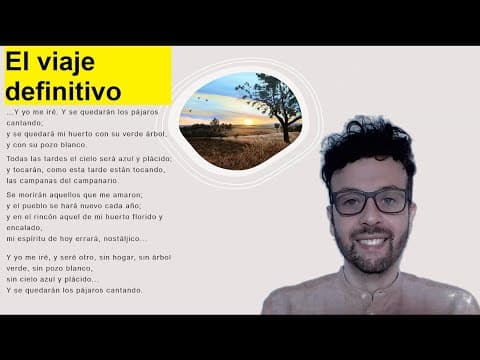
The poem is structured into four stanzas, with the first three stanzas containing three verses each, while the final stanza comprises four verses. This arrangement creates a rhythmic flow that enhances the poem's contemplative nature. The first stanza opens with a suspension point, employing a language that conveys suffering and a longing for another world. This sets the tone for the exploration of death, a recurring theme in universal literature.
In "El viaje definitivo," Jiménez addresses the theme of death with a sense of acceptance. The poet reflects on the transient nature of human life, suggesting that while individuals may perish, their essence remains intertwined with the natural world. The imagery of nature, particularly the references to trees and the landscape of his childhood, evokes a sense of nostalgia. Jiménez's relationship with nature is profound, as he sees it as a permanent fixture in contrast to the fleeting nature of human existence.
The poem is rich with symbols that represent both life and death. For instance, the mention of trees and the natural environment serves as a metaphor for continuity and renewal. Jiménez suggests that even in death, there is a connection to the earth and the cycle of life. The poet's nostalgia for his childhood and the natural world reflects a desire for permanence amidst the inevitability of mortality.
Jiménez's work is heavily influenced by modernism, which is evident in his use of symbolism and sensory imagery. The poem's language is evocative, creating a vivid picture of the natural world that surrounds the poet. This modernist approach allows Jiménez to explore complex emotions related to death and existence, presenting them in a way that resonates with readers.
"El viaje definitivo" concludes with a sense of circularity, mirroring the natural cycles of life and death. The poem encapsulates Jiménez's belief that death is not an end but a transformation, a theme that is both optimistic and reflective. Through his exploration of nature and the human experience, Jiménez invites readers to contemplate their own existence and the connections that bind them to the world around them.
In summary, Juan Ramón Jiménez's "El viaje definitivo" is a poignant reflection on life, death, and the enduring beauty of nature. The poem's modernist influences and its exploration of universal themes make it a significant work in the landscape of Spanish literature, encouraging readers to embrace the complexities of existence with a sense of hope and nostalgia.