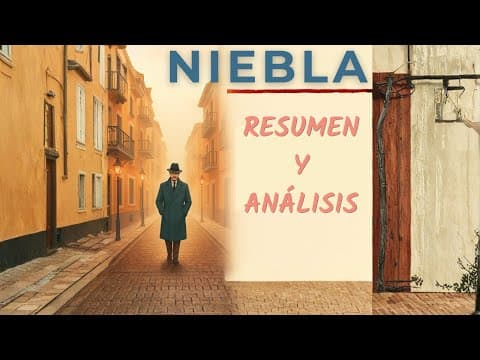
This blog post delves into Miguel de Unamuno's masterpiece 'Niebla', exploring its unique narrative style, the existential dialogue between the protagonist Augusto Pérez and Unamuno himself, and the philosophical themes of existence, identity, and the nature of reality.
Miguel de Unamuno, a prominent author and philosopher, is best known for his masterpiece, "Niebla". This work, subtitled "Una ni bola", introduces a unique narrative style that diverges from traditional realism, focusing primarily on dialogue rather than extensive description. In this blog post, we will explore the key elements of "Niebla", including its characters, themes, and the profound philosophical dialogue that unfolds between the protagonist, Augusto Pérez, and Unamuno himself.
Unamuno coined the term "ni bola" to describe his work, which can be interpreted as a novel of ideas. Unlike conventional novels that rely heavily on descriptive passages, "Niebla" is characterized by its minimal description and a focus on dialogue. The protagonist, Augusto Pérez, is depicted as an ordinary man, a "paseante de la vida" (a wanderer of life), who struggles to navigate his existence without a clear understanding of his own identity.
Augusto Pérez is an everyman, defined by his lack of extraordinary qualities. His name itself is an oxymoron: "Augusto" suggests greatness, while "Pérez" is a common surname. This duality reflects his character's journey through life, where he becomes infatuated with Eugenia, a woman he barely knows. His obsession leads him to pursue her relentlessly, uncovering details about her life, only to discover that she is engaged to another man, Mauricio.
As the story unfolds, Augusto's passion for Eugenia intensifies, culminating in their engagement. However, on the eve of their wedding, Eugenia abandons Augusto to return to Mauricio, leaving him heartbroken and contemplating suicide. In his despair, Augusto seeks out the author of an essay on suicide, leading him to the city of Salamanca to confront Unamuno.
In a groundbreaking narrative twist, Unamuno inserts himself into the story as a character. The dialogue between Augusto and Unamuno becomes a pivotal moment in literary history, exploring existential themes and the nature of reality. Unamuno, aware of Augusto's struggles, engages him in a conversation that challenges the very fabric of existence.
During their dialogue, Unamuno reveals to Augusto that he is merely a fictional character, a product of Unamuno's imagination and the readers' interpretations. This revelation terrifies Augusto, who grapples with the implications of being a mere construct of fiction. Unamuno's assertion that Augusto is not truly alive forces him to confront the essence of his existence.
The conversation serves as a metaphor for the relationship between God and humanity, where Unamuno represents the creator and Augusto symbolizes the created. This dynamic raises profound questions about free will, identity, and the search for meaning. Augusto's realization that he is a character in a story prompts him to desire a more authentic existence, free from the constraints of fiction.
As the dialogue progresses, Augusto expresses a yearning to escape the "niebla" (fog) that represents ignorance and the unexamined life. He desires to truly live, to feel, and to understand his existence beyond the confines of his fictional reality. Unamuno's philosophical exploration emphasizes the importance of self-discovery and the pursuit of one's own path in life.
In a poignant moment, Augusto challenges Unamuno, suggesting that perhaps it is the author who is the fictional entity, dependent on his characters for existence. This reversal of roles highlights the interdependence between creator and creation, echoing existential themes that resonate throughout the narrative.
The dialogue concludes with Augusto's exhaustion from the intense philosophical exchange, leaving readers to ponder the fate of both characters. Unamuno's ambiguous ending raises questions about free will and the nature of life and death. Did Augusto succeed in his suicide, or was he ultimately a victim of Unamuno's narrative control?
Unamuno's refusal to provide clear answers reflects his belief in the complexity of existence and the necessity of questioning ideologies and beliefs. The characters in "Niebla" are not mere protagonists; they are agonists, engaged in a struggle for understanding and meaning in a world shrouded in uncertainty.
In summary, "Niebla" is a profound exploration of existence, identity, and the human condition, inviting readers to reflect on their own lives and the nature of reality. Unamuno's genius lies in his ability to provoke thought and challenge perceptions, making "Niebla" a timeless work that continues to resonate with audiences today.