This blog post delves into Rudyard Kipling's poem 'The White Man's Burden,' exploring its historical context, structure, and the imperialist ideologies it conveys. The analysis highlights the poem's themes of racial superiority, the burdens of imperialism, and the complexities of Westernization in the modern world.
In this blog post, we will explore Rudyard Kipling's poem "The White Man's Burden," published in 1899. This poem has sparked significant discussion and debate due to its themes of imperialism and racial superiority. We will examine the historical context of Kipling's life, the structure of the poem, and provide a stanza-by-stanza analysis to uncover its deeper meanings.
Rudyard Kipling was born in Bombay, India, in 1865, and his experiences in colonial India greatly influenced his writing. The late 1800s were marked by a surge of imperialism, particularly in England, driven by economic, political, and religious motivations. This period saw the expansion of the British Empire and the scramble for Africa, where European powers competed for control over African territories.
Kipling's poem was written in the aftermath of the Spanish-American War, with a subtitle that references the United States and the Philippine Islands. The poem serves as a call to the United States to embrace the imperialist ideals that had characterized European colonialism, suggesting that it was now America's turn to take up the "white man's burden."
"The White Man's Burden" consists of seven stanzas, each containing eight lines. The poem follows an AABB rhyme scheme, although there are instances of slant rhyme throughout. The repeated phrase "take up the white man's burden" emphasizes the call to action for white men to engage in the civilizing mission of imperialism.
The term "white man's burden" refers to the belief that it is the responsibility of white people to conquer and civilize non-white populations, who are viewed as inferior. Kipling advocates for this burden, suggesting that it is a noble endeavor aimed at improving the lives of those deemed "savage."
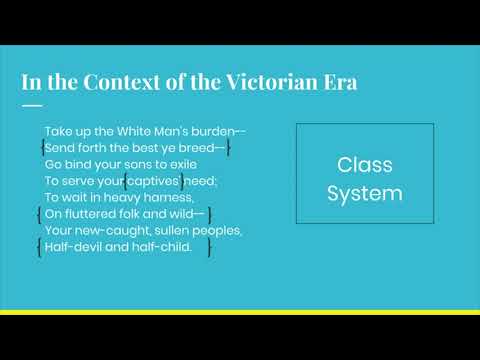
The poem opens with the imperative to "take up the white man's burden." This repetition underscores the importance of this call to action. The diction used, such as "bind," "exile," and "heavy harness," highlights the struggles and sacrifices that white men must endure in their civilizing mission. The depiction of the natives as "half devil and half child" reinforces the notion of their subhuman status.
In this stanza, Kipling emphasizes the superiority of the white race, suggesting that they must uphold their responsibility to civilize others. The call for patience and humility reflects an egotistical view of white men as noble saviors, while the metaphor of veiling the threat of terror evokes a sense of patriotism.
Kipling uses the phrase "savage wars of peace" to illustrate the paradox of achieving peace through conflict. The metaphor "fill full the mouth of famine" suggests that white men are obligated to eradicate suffering in conquered lands, while the use of personification implies that sickness must be actively fought against.
This stanza contrasts the notion of imperial rule with the hard labor required to civilize non-white populations. Kipling asserts that white men will not enjoy the fruits of their labor, as they are tasked with leaving behind a legacy for future generations.
Here, Kipling employs sarcasm to highlight the thanklessness of the white man's burden. Despite their efforts to help, white men receive blame and hatred from the very people they seek to uplift. The allusion to the biblical children of Israel serves to illustrate the ignorance of the natives regarding their own plight.
In this stanza, Kipling urges white men to embrace their burden without complaint. The imagery of silent and sullen natives reinforces their perceived inferiority, while the phrase "shall weigh your gods and you" suggests that white men will be judged for their actions.
The final stanza calls for a rejection of childish ideals and an embrace of the harsh realities of imperialism. Kipling suggests that taking on the white man's burden is a test of manhood, emphasizing the sacrifices made by white men in their civilizing mission.
Kipling's "The White Man's Burden" attempts to rationalize imperialist ideologies and the belief in racial superiority. While the poem reflects the sentiments of its time, the consequences of such beliefs have been complex and often detrimental. The forceful nature of imperialism has led to resistance and rejection of Westernization in many cultures, as seen in countries like India and various African nations.
However, some nations have successfully adopted Western ideals, leading to significant advancements. The legacy of Kipling's poem serves as a reminder of the complexities surrounding imperialism and the ongoing struggle for self-improvement and cultural identity in a globalized world.