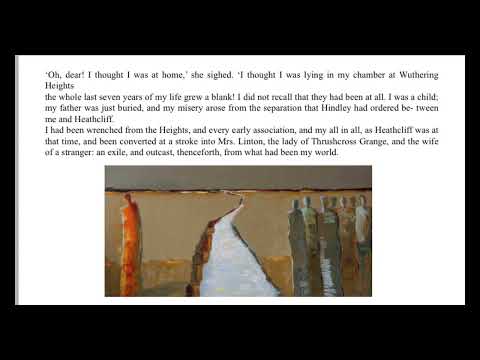
Chapter 12 of Wuthering Heights delves into Catherine's psychological turmoil as she grapples with her identity and the constraints of social order. The chapter highlights her longing for freedom and connection with Heathcliff, contrasting her past innocence with her current despair as she confronts the reality of her marriage to Edgar Linton.
In Chapter 12 of Emily Brontë's Wuthering Heights, we witness a profound exploration of Catherine Earnshaw's psychological state as she navigates the complexities of her identity and societal expectations. This chapter serves as a pivotal moment in the narrative, revealing Catherine's internal struggles and her longing for freedom amidst the constraints imposed by her marriage to Edgar Linton.
The chapter opens with a reflection on the Moors, a place where Catherine and Heathcliff could be their true selves, free from societal judgment. In contrast, at Thrushcross Grange, Catherine feels trapped by social conventions. The Moors symbolize a realm of enchantment and childhood innocence, a stark contrast to the oppressive social order that governs their adult lives.
Catherine's mention of the fairy cave under Peniston Crag introduces local folklore that suggests dire consequences for couples who do not marry within a year after crawling through the cave. This superstition foreshadows the tragic fate of Catherine and Heathcliff, hinting at the haunting nature of their love. The idea that they would be doomed to haunt the earth if they married others underscores the depth of their bond and the inevitability of their tragic end.
As the chapter progresses, Catherine's mental state deteriorates. She becomes delirious, oscillating between memories of her past and her current reality. Her feverish state leads her to question Edgar's love for her, revealing her deep-seated insecurities. Catherine's inability to recognize herself in the mirror symbolizes her identity crisis; she feels like a ghost of her former self, trapped in a life she never wanted.
Catherine's fear of her reflection in the mirror signifies her rejection of her identity as Mrs. Linton. She longs to return to her former self, the wild and free girl who roamed the Moors with Heathcliff. This moment encapsulates her internal conflict: she is torn between her societal role and her true desires. The mirror becomes a powerful symbol of self-recognition and the painful realization of her lost freedom.
Catherine's longing for the Moors intensifies as she expresses a desire to escape her current life. She reminisces about her childhood, wishing to return to a time when she was carefree and unburdened by societal expectations. Her plea to Nelly to open the window represents her yearning for liberation and a connection to the natural world that once brought her joy.
Chapter 12 of Wuthering Heights is a poignant exploration of Catherine's psychological turmoil as she grapples with her identity and the constraints of her marriage. The chapter highlights her longing for freedom and connection with Heathcliff, contrasting her past innocence with her current despair. Through the symbolism of the Moors and the mirror, Brontë masterfully illustrates the complexities of love, identity, and the human condition, setting the stage for the tragic events that will unfold in the narrative.