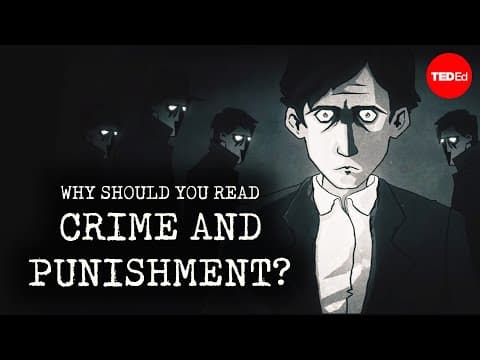
Fyodor Dostoyevsky's 'Crime and Punishment' delves into the psychological and moral struggles of Rodion Raskolnikov, a law student who commits murder, exploring themes of poverty, morality, and redemption against the backdrop of 19th century Saint Petersburg.
What drives someone to kill in cold blood? What goes through the murderer’s mind? And what kind of society breeds such people? These profound questions are at the heart of Fyodor Mikhailovich Dostoyevsky's seminal work, "Crime and Punishment," first serialized in 1866. This novel not only explores the psyche of its protagonist but also paints a vivid picture of the societal conditions of 19th century Russia.
At the center of the narrative is Rodion Romanovich Raskolnikov, a young law student living in the impoverished streets of Saint Petersburg. As the story unfolds, we learn that Raskolnikov is in dire financial straits, having exhausted his funds and sold his last valuables to an elderly pawnbroker. The letters from his rural home only deepen his despair, revealing the sacrifices his mother and sister have made for his education.
In a moment of desperation, Raskolnikov devises a plan to murder the pawnbroker and rob her, believing that this act will ultimately benefit society. However, the psychological ramifications of his crime prove to be far more complex than he anticipated.
Often regarded as one of the first psychological thrillers, "Crime and Punishment" transcends the mere exploration of Raskolnikov’s inner turmoil. Dostoyevsky masterfully brings to life the gritty underbelly of Saint Petersburg, from its dank taverns to its dilapidated apartments and claustrophobic police stations. The novel introduces a cast of characters that embody the struggles of the time, including Marmeladov, a former official who has succumbed to alcoholism, and Svidrigailov, a morally corrupt nobleman.
As Raskolnikov's family arrives in the city, their innocence starkly contrasts with the depravity surrounding them, intertwining their fates in unexpected ways.
Dostoyevsky's own life experiences heavily influenced the themes of the novel. Initially, he pursued a military career but was drawn to socialist ideas and intellectual circles that discussed radical texts banned by the Imperial government. His involvement with these groups led to his arrest, and many of his peers faced execution, only to be spared at the last moment. Dostoyevsky spent four years in a Siberian labor camp, an experience that profoundly altered his worldview, shifting his focus from social reform to spiritual concerns.
In his 1864 novella "Notes from Underground," he articulated his belief that utopian Western philosophies could never satisfy the contradictory yearnings of the human soul. This philosophical backdrop set the stage for "Crime and Punishment," which was conceived and completed shortly thereafter.
The narrative follows a common thread of a promising youth corrupted by urban life, yet it delves deeper into social critique. Raskolnikov's justification for murder—believing that his advancement at the cost of the pawnbroker's life would benefit society—echoes the doctrines of egoism and utilitarianism prevalent among Dostoyevsky's contemporaries. In his quest to transcend moral boundaries through intellect, Raskolnikov alienates himself from his own humanity.
Despite its heavy moral concerns, "Crime and Punishment" avoids being merely didactic. Each character is given a distinctive voice, contributing to the richness of the narrative. Remarkably, the novel maintains its suspense even after revealing the murder in the first act. The true essence of Raskolnikov's punishment unfolds through Dostoyevsky’s gripping portrayal of the ensuing social and psychological turmoil, ultimately leading to the exploration of redemption.
"Crime and Punishment" remains a timeless exploration of the human condition, grappling with themes of morality, poverty, and the quest for redemption. Dostoyevsky's profound insights into the psyche of his characters and the society they inhabit continue to resonate with readers, making this novel a cornerstone of Russian literature and a compelling study of the complexities of human nature.