This blog post delves into T.S. Eliot's poem 'The Love Song of J. Alfred Prufrock,' examining themes of alienation, communication struggles, and the search for meaning in a modern world. Through the lens of Prufrock's introspection, we explore the complexities of identity, societal expectations, and the burden of consciousness.
T.S. Eliot's poem "The Love Song of J. Alfred Prufrock" presents a profound exploration of the modern individual's struggle with identity, communication, and the search for meaning. In this analysis, we will delve into the themes and rhetorical devices employed by Eliot, particularly focusing on Prufrock's existential crisis and his reflections on life in a fragmented world.
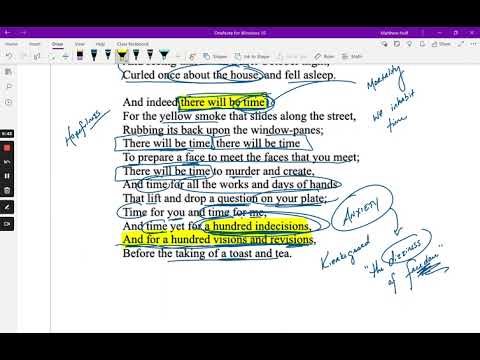
At the heart of Prufrock's contemplation is a haunting question: what if his life lacks ultimate meaning? In a world where traditional value systems seem inaccessible, Prufrock grapples with the notion that his existence can be quantified not by character or faith, but by mundane measures, such as coffee spoons. This realization becomes a source of crippling anxiety, prompting him to question how he should presume to navigate his life.
Eliot employs synecdoche throughout the poem, using parts of people to represent their whole selves. Prufrock observes the eyes, voices, and arms of those around him, each taking on a life of their own. He notes, "I know the voices but they are dying with a dying fall beneath the music from a farther room," suggesting a disconnect between himself and the people in his environment. The voices are muffled, and the eyes that fixate on him do so with a sense of judgment, reducing him to mere labels and perceptions.
Prufrock's self-perception is further complicated by his feelings of inadequacy. He describes the experience of being pinned and wriggling on the wall, akin to an insect specimen, suggesting that he feels dissected and defined by others rather than by his own self-expression. This negative portrayal of communication highlights the fractures in human connection, as he struggles to articulate his thoughts and feelings.
Prufrock's inability to communicate effectively reflects a broader human problem in the modern world. He feels trapped in a social jungle where only the confident thrive, while those like him drown in anxiety and despair. He laments, "It is impossible to say just what I mean," emphasizing the challenges of expressing oneself in a world filled with superficial interactions.
As he contemplates his surroundings, Prufrock observes the beauty of arms and faces, yet he questions whether these external stimuli influence his thoughts and actions. He wonders if he is merely a product of his environment, echoing the naturalist views of earlier writers who saw humanity as subject to biological impulses and unconscious desires.
Prufrock envies the simplicity of a sub-human existence, wishing he could escape the burdens of self-awareness and moral contemplation. He reflects on the weight of consciousness, recognizing that while humans have the capacity for deep thought, this awareness can also lead to paralysis by analysis. He expresses a desire to be reduced to mere instinct, free from the expectations and judgments of society.
In a poignant moment, he questions whether it would have been worthwhile to engage in the complexities of life, pondering if the minutiae of daily existence hold any significance. This leads him to confront the slippery nature of language and the difficulty of conveying meaning, as he grapples with the frustration of not being understood.
Prufrock's reflections culminate in a recognition of his own insignificance. He declares, "No, I am not Prince Hamlet nor was meant to be," acknowledging that he does not possess the heroic qualities of traditional literary figures. Instead, he sees himself as an attendant lord, a mere tool in the grand narrative of life, filled with sound and fury but lacking substance.
As he grows older, his contemplations shift from grand existential questions to trivial concerns, such as how to part his hair or whether to eat a peach. This reduction of his aspirations reflects the disillusionment of modern existence, where profound thoughts are overshadowed by mundane choices.
In the closing lines of the poem, Prufrock imagines himself at the beach, contemplating the vastness of the ocean and the mythical voices that once called to him. However, he realizes that these voices do not sing to him, symbolizing his isolation in a world that feels indifferent to his struggles. The poem concludes with the haunting image of human voices waking him from his reverie, leaving him to drown in the noise of modern life.
Eliot's "The Love Song of J. Alfred Prufrock" serves as a poignant reflection on the complexities of modern existence. Through Prufrock's introspection, we are invited to consider the challenges of communication, the search for identity, and the burden of consciousness in a fragmented world. Ultimately, Prufrock's journey reveals the profound alienation that can arise in the quest for meaning, leaving us to ponder our own place in the tapestry of life.