This blog post delves into T.S. Eliot's modernist poem 'The Love Song of J. Alfred Prufrock,' examining its themes of social alienation, existential questioning, and the struggle for identity in a fragmented modern world. Through a close reading of the poem, we explore Eliot's innovative techniques, classical allusions, and the profound anxieties faced by the speaker, J. Alfred Prufrock.
Today, we will discuss T.S. Eliot's seminal modernist poem, "The Love Song of J. Alfred Prufrock." This poem, published in 1915, is often regarded as one of the quintessential works of modern poetry. Eliot, alongside contemporaries like Ezra Pound, broke new ground with an innovative approach that reflected the complexities of the modern era, particularly in the aftermath of World War I.
Eliot's poetry is characterized by its fragmented structure and lack of linear narrative, mirroring the disjointed reality of the modern world. He believed that poetry should challenge readers' assumptions and provoke thought, moving away from the traditional sing-song rhyme and meter. Instead, Eliot sought to explore the depths of human experience in a time marked by social alienation and existential dread.
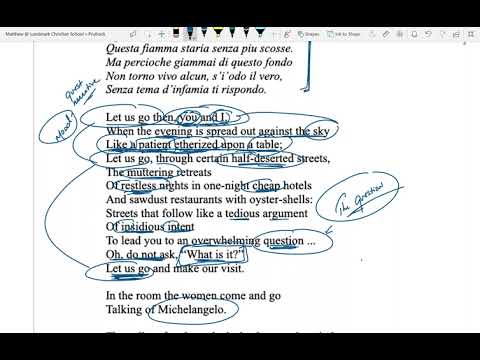
In "Prufrock," Eliot draws heavily on classical influences, making allusions to figures such as Shakespeare and Dante. The poem opens with an epigraph from Dante's Inferno, setting a tone of introspection and confession. This connection to the past serves as a backdrop against which Prufrock grapples with his identity and place in a world that feels increasingly unmoored.
The poem begins with an invitation:
"Let us go then, you and I, when the evening is spread out against the sky like a patient etherized upon a table."
This simile establishes a mood of paralysis and numbness, suggesting that the evening, while romantic, is also filled with a sense of dread. The imagery of an etherized patient evokes feelings of helplessness, reflecting Prufrock's own emotional state as he navigates a social landscape that feels alien and overwhelming.
As Prufrock ventures into the city, he describes half-deserted streets and restless nights, painting a picture of urban isolation. The refrain of "let us go" transforms from a call to adventure into a plea for liberation from the burdens of consciousness and societal expectations. Prufrock's indecision and anxiety are palpable as he grapples with the question of his own existence:
"Oh, do not ask, 'What is it?' Let us go and make our visit."
This refrain underscores his fear of confronting the deeper questions of life, echoing Hamlet's existential dilemma.
At the dinner party, Prufrock observes the women who come and go, discussing Michelangelo, a figure emblematic of artistic greatness. Yet, he feels disconnected, unable to engage in meaningful conversation. This highlights his profound sense of alienation, as he realizes he is not part of the grand narrative of human achievement.
The imagery of yellow fog and smoke further emphasizes the obscurity and confusion of his surroundings. The fog, described as rubbing against the window panes, symbolizes the blurring of reality and the difficulty of discerning one's path in life.
Eliot's exploration of time is central to Prufrock's internal struggle. He reflects on the mundane rituals of life, stating:
"There will be time, there will be time to prepare a face to meet the faces that you meet."
This repetition of "there will be time" suggests both procrastination and a glimmer of hope. Prufrock contemplates the weight of his choices, feeling paralyzed by the multitude of possibilities that modern life presents. The anxiety of decision-making becomes a recurring theme, as he grapples with the implications of his actions.
As Prufrock continues to reflect on his existence, he poses the question:
"Do I dare disturb the universe?"
This moment encapsulates his fear of making choices that could have significant consequences. He wonders if his actions matter in an indifferent universe, where the weight of his decisions feels insurmountable. The poem's exploration of existential dread culminates in Prufrock's realization that he has measured out his life in trivialities:
"I have measured out my life with coffee spoons."
This line poignantly captures the essence of his struggle, suggesting that his life has been reduced to mundane routines devoid of deeper meaning.
In "The Love Song of J. Alfred Prufrock," T.S. Eliot masterfully captures the anxieties and alienation of modern existence. Through innovative techniques and rich allusions, he invites readers to reflect on the complexities of identity, time, and the search for meaning in a fragmented world. Prufrock's journey is not just a personal one; it resonates with the universal human experience of grappling with the weight of existence in an increasingly chaotic society. As we continue to explore this poem, we will uncover more layers of meaning and insight into the modern condition.