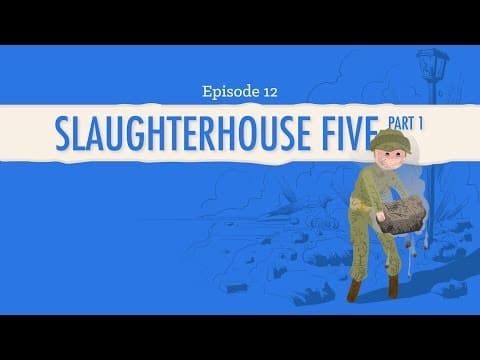
Kurt Vonnegut's Slaughterhouse-Five is a profound antiwar novel that intertwines the horrors of World War II with the complexities of time travel and trauma. Through the character of Billy Pilgrim, Vonnegut explores the impact of war on the human psyche, using humor and nonlinear storytelling to convey the unspeakable nature of violence and loss.
In this installment of Crash Course Literature, we delve into Kurt Vonnegut's seminal work, Slaughterhouse-Five, also known by its alternate title, The Children’s Crusade. This novel stands as one of the most significant antiwar texts of the late twentieth century, written during the tumultuous period of the Vietnam War. Vonnegut's narrative chronicles the devastating bombing of Dresden during World War II while simultaneously addressing the broader implications of modern warfare.
At the heart of Slaughterhouse-Five lies a profound question: What role can literature, particularly literary fiction, play in confronting large-scale violence? While the novel addresses serious themes of war and trauma, it also incorporates a surprising amount of humor, creating a unique reading experience that balances the gravity of its subject matter with moments of levity.
The protagonist of Slaughterhouse-Five, Billy Pilgrim, experiences life in a non-linear fashion, describing himself as "unstuck in time." This narrative structure allows readers to witness his life events out of chronological order, reflecting the disorientation caused by trauma. The key events in Billy's life include:
Kurt Vonnegut's insights into the horrors of war are deeply rooted in his own experiences. He served in the U.S. Army during World War II, was captured during the Battle of the Bulge, and was interned in Dresden, where he witnessed the aftermath of the bombing. The first and last chapters of Slaughterhouse-Five are written in the first person, reminding readers that they are engaging with a narrative crafted from real experiences. This choice disrupts the conventional reading experience, paralleling Billy Pilgrim's own disconnection from time.
Between February 13th and 15th, 1945, Allied forces dropped nearly 4,000 tons of bombs on Dresden, resulting in a catastrophic firestorm that obliterated much of the city and claimed tens of thousands of lives. Vonnegut grapples with the challenge of conveying such immense suffering through his narrative. He often resorts to vague language and figures of speech to depict the unspeakable horrors of war, as seen in Billy's recollections of the destruction: "There was a fire-storm out there. Dresden was one big flame."
Vonnegut's narrative reflects the difficulty of articulating trauma. He acknowledges that the words he writes are insufficient to capture the full extent of the destruction and loss. In the opening lines of the novel, he states, "All this happened, more or less. The war parts, anyway, are pretty much true." This ambiguity invites readers to question the reliability of memory and the nature of truth in recounting traumatic events.
Despite the heavy themes, Slaughterhouse-Five employs humor and absurdity to confront the grim realities of war. Vonnegut's use of metaphors, such as comparing the sun to an "angry little pinhead," serves to distance the reader from the direct horror of the events. This technique mirrors the human tendency to cope with trauma through humor, even in the face of overwhelming grief.
Slaughterhouse-Five is not just a narrative about war; it is a complex exploration of how we process trauma, memory, and the absurdity of existence. Vonnegut's unique storytelling invites readers to reflect on the impact of war on the human psyche and the stories we tell ourselves about the past. As we prepare to explore the Tralfamadorian philosophy and its implications for understanding violence in the next installment, we are reminded of the enduring relevance of Vonnegut's work in examining the human condition.
Next week, we will continue our discussion of Slaughterhouse-Five, focusing on the Tralfamadorians and their perspective on time and existence, as well as the broader implications of anti-war literature in addressing the realities of conflict.