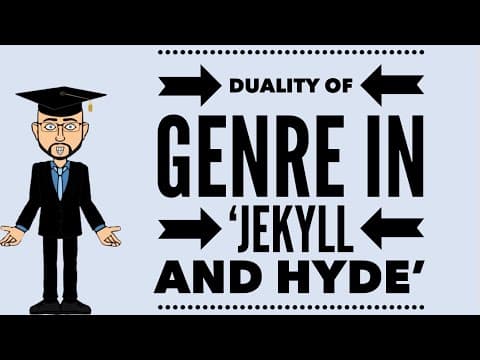
Stevenson's 'Jekyll and Hyde' masterfully intertwines gothic fiction and scientific case study genres to explore the dual nature of humanity, creating a chilling realism that enhances its themes of fear and rationality.
Robert Louis Stevenson’s novella, The Strange Case of Dr Jekyll and Mr Hyde, is often analyzed through its prominent theme of the dual nature of humanity. This theme has been a focal point since the novella's publication in 1886, with early critics like Andrew Lang noting the concept of a double personality inherent in every individual. While this theme is overtly presented through the characters and settings, Stevenson’s use of genre adds a layer of complexity that enriches the narrative.
At first glance, Jekyll and Hyde fits neatly into the gothic fiction genre, characterized by elements such as monsters, horror, death, and ominous settings. The novella is rife with these conventions, particularly through its use of nighttime settings and foreboding weather. For instance, the story opens with Enfield’s walk at three o'clock on a black winter morning, and Utterson’s restless night culminates in his first encounter with Hyde after 10 p.m. The murder of Carew occurs amidst a fog that envelops the city, further emphasizing the gothic atmosphere.
However, Jekyll and Hyde also aligns with the conventions of a scientific case study, a popular format in Victorian Britain. The novella’s full title echoes the style of scientific literature, suggesting a clinical examination of its subjects. Ann Stiles, in her book Popular Fiction and Brain Science in the Late 19th Century, highlights how Stevenson’s narrative mimics and critiques the rationality of scientific case studies through its seemingly objective voice.
The novella begins with a third-person narrative focused on Utterson, resembling the detached tone of scientific journals. The letters from Lanyon and Jekyll at the end serve as the anecdotal and numerical evidence typically found in these studies. This structure not only reflects the conventions of scientific writing but also enhances the chilling realism of the story.
The structure of Jekyll and Hyde is particularly noteworthy. It opens with a third-person narrative, transitions to first-person accounts through letters, and culminates in Jekyll’s own narrative. This progression mirrors the structure of a scientific case study, where an objective overview is followed by personal testimonies. Readers of the time would likely recognize this format, adding to the novella’s impact.
Stevenson’s choice to blend these genres serves a dual purpose. It heightens the realism of the narrative, as the Victorian setting is familiar to readers, while also creating a sense of dread through the gothic elements. The juxtaposition of the rational and the irrational, the scientific and the supernatural, amplifies the horror of the story.
The interplay between gothic fiction and scientific analysis introduces a fundamental conflict. As noted by Stiles, gothic horror aims to evoke fear and mystery, while science seeks to rationalize and explain phenomena. This inherent opposition is where Stevenson’s genius lies. By merging these genres, he crafts a narrative that embodies a split personality, mirroring the duality of its central characters.
Stevenson does not merely replicate the dry, unemotional tone typical of scientific case studies; he infuses it with the emotional weight and terror characteristic of gothic fiction. This combination results in a novella that itself suffers from a case of split personality, reflecting the very themes it explores.
In The Strange Case of Dr Jekyll and Mr Hyde, Stevenson intricately weaves together the genres of gothic fiction and scientific case study to explore the duality of humanity. This sophisticated approach not only enhances the narrative’s chilling realism but also deepens the reader's engagement with its themes. The novella stands as a testament to Stevenson’s literary prowess, showcasing how form can reflect content in profound and unsettling ways.