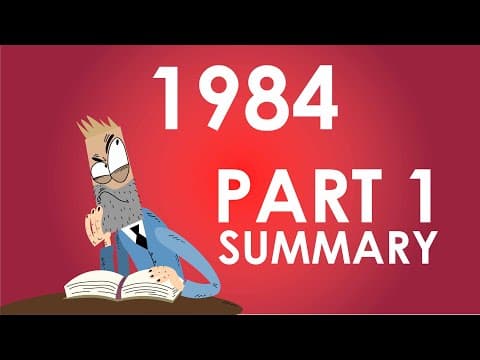
In the first part of George Orwell's 1984, we are introduced to Winston Smith, a government worker in a totalitarian regime known as Oceania. The narrative explores themes of surveillance, manipulation of truth, and the oppressive nature of the Party, led by Big Brother. Winston's internal conflict and his interactions with colleagues and the oppressive state set the stage for a gripping tale of rebellion and thought control.
George Orwell's 1984 presents a chilling vision of a totalitarian future. Set in April of 1984, the story unfolds in a place formerly known as Britain, now referred to as Airstrip One, which is part of the superstate Oceania. This blog post summarizes the key elements of the first part of the novel, focusing on the protagonist, Winston Smith, and the oppressive regime he navigates.
The narrative begins with Winston Smith, a 39-year-old man working for the government at the Ministry of Truth. Ironically, this ministry is responsible for distorting reality by manipulating news, entertainment, and education to ensure that the populace supports the Party. The government is divided into four ministries: Truth, Peace, Love, and Plenty, each controlling different aspects of life in Airstrip One.
As Winston makes his way home, he is constantly reminded of the Party's presence through propaganda. Posters featuring the face of Big Brother, the Party's leader, proclaim that "Big Brother is watching you." This omnipresent surveillance creates an atmosphere of fear and control, reminiscent of a reality show gone horribly wrong.
Upon entering his flat, Winston seeks refuge in a small alcove, away from the prying eyes of the Telly screen, which serves as both a television and a surveillance device. Here, he engages in an act of rebellion by writing in his diary, an act that is punishable by death or a lengthy sentence in a forced labor camp. This diary becomes a symbol of his desire for freedom and truth in a world where both are systematically suppressed.
Winston reflects on the daily ritual known as the Two Minutes Hate, where Party members express their hatred for Emmanuel Goldstein, a figure representing opposition to the Party. During this event, Winston briefly locks eyes with his superior, O'Brien, and senses a shared disdain for the Party, leading him to wonder if O'Brien might be part of the Brotherhood, a group seeking to overthrow the regime.
Winston's dissatisfaction with the Party grows as he contemplates the extent of its manipulation of history. His job at the Ministry of Truth involves altering historical records to fit the Party's narrative. During lunch with his colleague Syme, who is working on the latest edition of Newspeak, the Party's official language, they discuss how the simplification of language is designed to limit thought and prevent rebellion. Syme's enthusiasm for Newspeak highlights the absurdity of the Party's control over language and, by extension, reality.
Winston becomes increasingly obsessed with the Party's corruption and the idea that they could declare that two plus two equals five without anyone questioning it. He realizes that the true essence of freedom lies in the ability to assert that two plus two equals four, a fundamental truth that the Party seeks to obliterate.
In a moment of introspection, Winston wanders into the prole district, where the non-Party members live. The proles make up 85 percent of the population, yet they remain largely ignored by the Party. In a shop, he purchases a glass paperweight, an object that symbolizes a connection to a past that the Party wishes to erase.
As he leaves the shop, Winston encounters Julia, a woman he is both attracted to and suspicious of, fearing she might be a spy for the Thought Police. This encounter heightens his anxiety about being discovered for his rebellious thoughts, leading him to contemplate the dire consequences of Thoughtcrime, the act of thinking against the Party's ideology.
The first part of 1984 sets the stage for a profound exploration of totalitarianism, surveillance, and the manipulation of truth. Through Winston's experiences and reflections, Orwell illustrates the oppressive nature of the Party and the internal struggle of individuals seeking freedom in a world dominated by fear and control. As the story unfolds, readers are left to ponder the implications of such a society and the resilience of the human spirit in the face of overwhelming oppression.