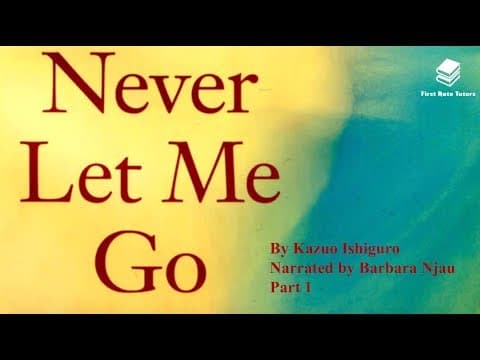
This blog post provides a comprehensive overview of Kazuo Ishiguro's novel 'Never Let Me Go', detailing its context, the author's background, and a summary of the plot, focusing on the lives of clones in a dystopian society and their complex relationships.
In this blog post, we delve into Kazuo Ishiguro's novel "Never Let Me Go," a complex and detailed narrative that explores themes of humanity, cloning, and the ethical implications of scientific advancements. This overview will cover the context of the novel, the author's background, and a summary of the key events that shape the story.
Kazuo Ishiguro, born in Japan in 1954, moved to England as a child. His experiences in a private school in Surrey are reflected in the novel's setting, particularly through the depiction of Hailsham, a boarding school for clones. Ishiguro studied English and philosophy at Kent University and later became a social worker before pursuing a master's in creative writing. His narrative style often features retrospective storytelling, where characters recount their memories in a restrained manner, a technique evident in the character of Kathy, the novel's narrator.
"Never Let Me Go" is set in a dystopian version of 1990s England, where cloning is used to prolong the lives of humans. In this world, clones are created for the sole purpose of donating their organs to extend the lives of their human counterparts. This premise raises profound ethical questions about the value of life and the treatment of beings created for exploitation.
The novel presents a stark contrast to utopian ideals. While a utopia represents a perfect society, a dystopia is characterized by oppressive societal control and the illusion of a perfect world. In Ishiguro's narrative, the clones live in a segregated environment, unaware of their fate until it is too late. The story critiques the moral implications of a society that sacrifices the lives of clones for the benefit of others.
The narrative begins with Kathy, a 31-year-old carer who reflects on her life at Hailsham. As a clone, she has spent 12 years caring for other clones who have donated their organs. Kathy reminisces about her time at Hailsham, where she and her friends, Ruth and Tommy, navigated the complexities of their existence.
At Hailsham, students are pressured to be creative, with artistic talent being highly valued. Kathy recalls an incident where Tommy, who struggles with creativity, is bullied. However, a guardian named Miss Lucy reassures him that he does not need to conform to these expectations. This moment highlights the tension between individuality and societal expectations.
The students engage in art exchanges, where they submit their work for tokens, but they soon realize that their art is being exploited by the school's authorities. Kathy also describes the fear surrounding the woods behind the school, where rumors of danger loom large.
As the characters grow older, they move to cottages, where they experience a semblance of independence. However, the shadow of their predetermined fates looms over them. Kathy's feelings for Tommy complicate her friendship with Ruth, who is dating him. The dynamics of their relationships evolve as they grapple with their identities and the reality of their existence as clones.
The trio's journey leads them to Norfolk, where they hope to find Ruth's "possible," the human from whom she was cloned. This quest symbolizes their search for identity and connection to the world outside their controlled environment. During this trip, they confront the harsh truths of their lives and the limitations imposed upon them.
As the story progresses, the characters face the reality of organ donation. Ruth's health deteriorates, prompting Kathy to become her carer. In a poignant moment, Ruth apologizes for her past behavior and encourages Kathy and Tommy to seek a deferral for their donations, a rumor that suggests couples might delay their fate if they are in love.
Ultimately, they learn from Miss Emily, a former guardian, that deferrals are merely a myth. The novel culminates in a heartbreaking conclusion as Tommy and Kathy confront their destinies, highlighting the emotional weight of their existence.
Kazuo Ishiguro's "Never Let Me Go" is a profound exploration of humanity, identity, and the ethical dilemmas surrounding cloning. Through the lens of Kathy's memories, readers are invited to reflect on the implications of a society that commodifies life. This summary serves as a foundation for understanding the novel's intricate themes and characters, setting the stage for a deeper analysis in the second part of our exploration.