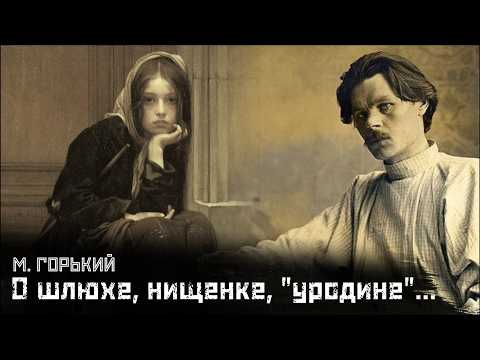
This blog post delves into the female characters in Maxim Gorky's stories, highlighting their struggles and societal contexts. It discusses the themes of poverty, social inequality, and the emotional depth of Gorky's protagonists, particularly focusing on the stories 'Nishenka' and 'Once in Autumn.'
Recently, I spent an evening with a collection of stories by Maxim Gorky, and I found several narratives that explore the fates of women, marked by the strokes of their time. This period, characterized by class distinctions, often predetermined the paths of individuals. I thought it would be a good idea to discuss these stories together.
What struck me about these novellas is that, while I haven't read all the literature from the late 19th century, many female characters I encountered typically fell into two archetypes. The first is the so-called Turgenev lady—sensitive, delicate, and often suffering from unrequited or unhappy love, usually in the context of a noble estate or during a foreign trip. This portrayal aligns with the elite's experiences, where suffering was a refined affair, reserved for the upper classes.
However, about 90% of the population experienced life in vastly different conditions, often facing struggles that were not romanticized. In Gorky's works, the female characters often serve as background figures, complementing the broader narrative. Yet, in this collection, I found stories that center on women, prompting me to reflect on their significance.
Maxim Gorky, whose real name was Alexei Peshkov, wrote about various social classes, dedicating much of his work to the struggles and aspirations of ordinary people. Gorky himself experienced hardship in his youth, which informed his understanding of social issues. His stories provide a vivid context for the time, which many of us have only a vague understanding of.
Let’s begin with the story "Nishenka," first published in the newspaper Volgar in 1893. This story was not included in Gorky's complete works during his lifetime but was later reprinted from the newspaper text. The narrative opens with Pavel Andreevich, a seemingly successful and content individual, contemplating life as he prepares for a vacation to Crimea. He reflects on the nature of happiness and the folly of those who demand too much from life.
As he strolls along the waterfront, he encounters beggars, including a young girl who begs for alms. This encounter jolts him, as he is confronted with the stark reality of poverty that contradicts his beliefs about meritocracy. The girl, described as angelically beautiful, reveals her tragic background—her father died from alcoholism, and her mother was a victim of domestic violence. This moment creates a cognitive dissonance for Pavel, who struggles to reconcile his worldview with the harsh realities faced by the girl.
Pavel's internal conflict deepens as he grapples with the societal structures that perpetuate such suffering. He realizes that individual efforts to help are insufficient; the responsibility lies with society as a whole. Gorky uses this character to illustrate the grotesque social stratification of his time, where the wealthy remain indifferent to the plight of the poor.
The next story, "Once in Autumn," is autobiographical and recounts Gorky's own experiences in his youth. First published in 1895, it describes a time when he found himself in a foreign city, destitute and alone. Gorky encounters a young girl named Natasha, who, like the girl in "Nishenka," is also trapped in a cycle of poverty and abuse.
Natasha's story is heartbreaking; she is a victim of domestic violence and exploitation. Gorky paints a vivid picture of her struggles, highlighting her resilience despite the brutality she faces. The narrative reveals the emotional depth of Natasha, who, despite her circumstances, finds a way to connect with Gorky, offering him comfort in their shared misery.
This story serves as a poignant reminder of the human capacity for empathy, even in the direst situations. Natasha's character embodies the tragic fate that many women faced during this era, often relegated to lives of despair and exploitation.
Gorky's stories resonate with themes of social injustice and the human condition. They reflect the stark realities of life for women in the late 19th century, often overshadowed by the romanticized narratives of the elite. Through his characters, Gorky critiques the societal structures that perpetuate inequality and suffering.
In another story, Gorky explores the relationship between a stationmaster and a kitchen maid, highlighting the mundane yet profound interactions that reveal deeper truths about human connection and loneliness. The characters, though seemingly ordinary, embody the struggles of their time, making Gorky's work relevant even today.
Maxim Gorky's exploration of female characters in his stories provides a powerful lens through which to understand the social dynamics of his time. His narratives are not just tales of individual suffering but reflections on the broader societal issues that continue to resonate. Gorky's ability to capture the essence of human experience, particularly the struggles of women, solidifies his place as a significant literary figure.
For those interested in delving deeper into the past and understanding the present, Gorky's short prose is highly recommended. It offers clarity and insight into the human condition, encouraging readers to reflect on their own lives and the world around them.