This blog post examines the complexities of Jay Gatsby's character in F. Scott Fitzgerald's 'The Great Gatsby,' exploring themes of aspiration, the American Dream, and the consequences of nostalgia, ultimately questioning whether Gatsby can truly be considered 'great.'
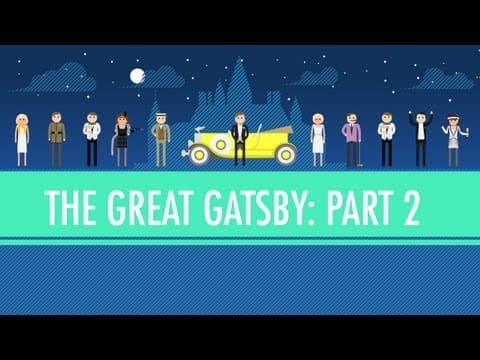
In this installment of Crash Course Literature, we delve into F. Scott Fitzgerald's iconic novel, The Great Gatsby. Despite its brevity, the novel is rich with complexity and nuance, prompting the question: Is Gatsby great? This exploration will unpack the layers of Gatsby's character, the themes of aspiration and nostalgia, and the societal critiques embedded within the narrative.
Fitzgerald's The Great Gatsby presents characters that are not particularly likable, which raises the challenge of engaging readers with a story centered around individuals who often elicit disdain. However, Fitzgerald employs heightened language and a rhythmic pace that captivates the reader from the very first sentence. The novel's opening line, "In my younger and more vulnerable years, my father gave me some advice I've been turning over in my mind ever since," sets a compelling tone that resonates throughout the text.
The descriptions in The Great Gatsby are strikingly beautiful. For instance, Daisy's voice is described as sounding "full of money," and the imagery surrounding Jordan Baker evokes a sense of nostalgia and loss. Fitzgerald's lush prose elevates Gatsby's experiences to epic proportions, suggesting a kind of greatness that transcends the superficiality of his life.
As noted by critic Matthew J. Bruccoli, Gatsby's greatness lies in his unwavering commitment to his aspirations. He embodies the archetype of the self-made man, striving for success and acceptance in a world that often dismisses him. Yet, there is irony in the title of the novel; Gatsby's life is a spectacle, akin to a carnival attraction, where his wealth and status are exaggerated and ultimately hollow.
A significant theme in both The Great Gatsby and Shakespeare's Romeo and Juliet is the obsession with controlling time. Gatsby's desire to recreate the past with Daisy reflects a longing for an idealized version of life that is ultimately unattainable. His famous line, "Can't repeat the past? Why of course you can," encapsulates this tragic delusion. This yearning for restoration is not unique to Gatsby; it resonates with broader societal tendencies to romanticize history and seek a return to a perceived golden age.
Gatsby's story is intricately tied to the American Dream, representing both its allure and its pitfalls. He rises from humble beginnings to immense wealth, yet his success is overshadowed by the moral decay of the society around him. The novel critiques the hypocrisy of Prohibition-era America, where illegal activities are rampant, yet those who engage in them, like Gatsby, are vilified.
The novel's surviving characters—Tom and Daisy Buchanan, Jordan Baker, and Nick Carraway—embody a carelessness that is both privileged and destructive. They navigate their lives without regard for the consequences of their actions, leaving a trail of devastation in their wake. Fitzgerald illustrates that this carelessness is more monstrous than outright cruelty, as it reflects a profound lack of empathy and accountability.
Ultimately, Gatsby's tragedy lies in his relentless pursuit of an unworthy dream. While he is a great man in terms of ambition and aspiration, his fixation on an idealized past blinds him to the realities of his present. The novel suggests that the true tragedy is not in dreaming but in chasing dreams that are fundamentally flawed.
In conclusion, the question of whether Gatsby is great is complex. Jay Gatsby is indeed a great man, driven by dreams and aspirations, yet he must navigate the treacherous waters of a society that rewards carelessness and superficiality. As readers, we are left to ponder the nature of greatness and the importance of the dreams we choose to pursue. Gatsby's story serves as a cautionary tale about the dangers of nostalgia and the pursuit of unattainable ideals.
As we reflect on Gatsby's journey, we are reminded that greatness must be tempered with wisdom and discernment in our aspirations.
Thanks for joining this exploration of The Great Gatsby.