This blog post delves into the poem 'Rain and Language' by Jagdish Gupta, exploring its themes of nature, emotions, and the profound connection between rain and life. The analysis highlights the poet's unique ability to convey deep meanings through the imagery of rain, illustrating how it cleanses and revitalizes both nature and human emotions.
In this blog post, we will explore a beautiful poem titled "Rain and Language" by the esteemed poet Jagdish Kumar Gupta. Born in 1924 and passing away in 2001, Gupta was a prominent figure in modern Hindi poetry and an influential educator. His contributions to Hindi literature have earned him a significant place among the leading poets of the new Hindi poetry movement, alongside notable contemporaries like Ram Swaroop Chaturvedi and Vijaydev Narayan Shahi.
Jagdish Gupta was not only a poet but also a painter, creating a bridge between literature and visual art. His works reflect a deep understanding of human emotions and the natural world, making his poetry resonate with readers on multiple levels. Some of his notable works include "Aankh Bhar Dekha Kahan," "Nadi Ka Aaveg," and "Badhalon Ki Chaar Panktiyan."
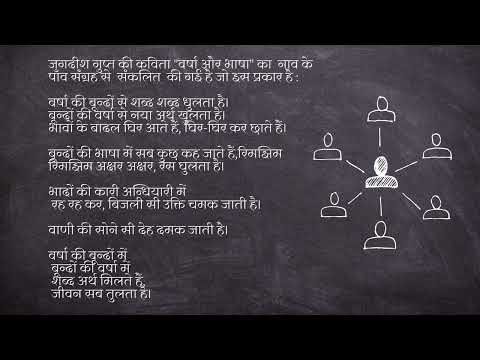
The poem "Rain and Language" is part of Gupta's collection "Naw Ke Paon." It beautifully captures the essence of rain and its metaphorical significance in our lives. The poem begins with the lines:
"वर्षा की बूंदों से शब्द शब्द घुलता है
बूंदों की वर्षा से नया अर्थ खुलता है
भावों के बादल घिरते हैं घिर घिर कर छाते हैं
बूंदों की भाषा में सब कुछ कह जाते हैं."
These lines set the tone for a profound exploration of how rain influences language, emotions, and life itself.
In this opening line, Gupta suggests that the raindrops cleanse not only the environment but also the words and thoughts within us. This serves as a metaphor for purification, where every emotion becomes fresh and rejuvenated.
Here, the poet conveys that rain brings new energy and meaning to nature. It offers us a fresh perspective on life, allowing us to understand deeper meanings that may have previously eluded us.
This line illustrates how, during the rainy season, emotional clouds gather and envelop us. It reflects the depth and breadth of emotions that rain can evoke, creating a rich tapestry of feelings.
Gupta emphasizes that raindrops communicate without words. They convey life's subtle signals and the beauty of nature, highlighting the idea that not all communication is verbal.
The rhythmic sound of raindrops is likened to poetry itself, where the essence of words and emotions blends together, creating a musical quality that enhances the beauty of language.
In this line, the poet draws a parallel between the flashes of lightning during a storm and sudden insights or inspirations that illuminate our minds, bringing joy and clarity amidst darkness.
Here, Gupta highlights the power of words when used effectively. Just as gold shines brightly, well-crafted language can have a profound impact, enhancing the significance of our expressions.
This line reiterates the idea that raindrops infuse life and language with new meanings, symbolizing the inspiration that nature provides.
In the concluding line, Gupta asserts that rain brings balance and peace to life. It signifies that rain is not merely a natural phenomenon but a source of hope and energy, pointing towards new beginnings.
In "Rain and Language," Jagdish Gupta masterfully portrays rain as a powerful force that imparts new meanings to life, emotions, and language. The poem serves as an inspiration to appreciate the subtle and beautiful intricacies of life, encouraging us to find meaning in the everyday experiences that surround us. Through his vivid imagery and profound insights, Gupta invites readers to reflect on the deeper connections between nature and human existence.
Thank you for joining me in this exploration of Jagdish Gupta's poetic world. I hope this analysis enriches your understanding and appreciation of his work.