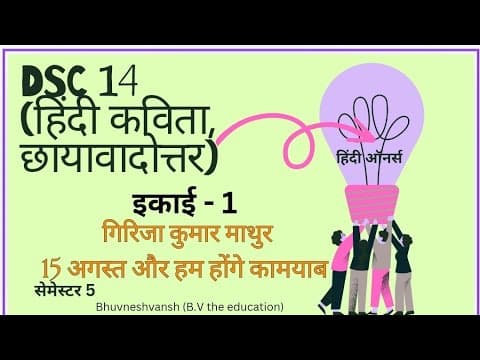
This blog post delves into the life and literary contributions of Girija Kumar Mathur, focusing on his notable poems '15 August' and 'We Shall Succeed'. It explores the themes of freedom, struggle, and hope in Mathur's work, reflecting on the socio-political context of his time and the enduring relevance of his messages.
In this blog post, we will explore the life and literary contributions of the esteemed Hindi poet Girija Kumar Mathur. Known for his romantic sensibilities and profound reflections on reality, Mathur's poetry resonates with themes of freedom, struggle, and hope. We will specifically analyze two of his significant poems included in the curriculum: '15 August' and 'We Shall Succeed'.
Girija Kumar Mathur was born in 1918 in Guna, Madhya Pradesh. He received his early education in Jhansi, Uttar Pradesh, and later pursued English and law degrees from Lucknow. Initially, he practiced law but eventually transitioned to work with All India Radio and Doordarshan. Mathur passed away in 1994, leaving behind a rich legacy in modern Hindi literature.
Mathur is celebrated as a prominent poet of modern Hindi literature, particularly known for his contributions to the genre of new poetry. His notable works include:
His critical writings, such as Seemaen aur Sambhavnayein, reflect his engagement with the evolving landscape of Hindi poetry. Mathur's poetry is characterized by its originality and unique style, employing free verse and a musical quality that captures the essence of contemporary life.
The poem '15 August' was penned during a pivotal moment in Indian history—the dawn of independence. Mathur captures the essence of this transformative period, reflecting on the challenges and aspirations that accompanied the newfound freedom.
The poem opens with a call for vigilance, urging the guardians of the nation to remain alert even in the face of victory. Mathur writes:
"Aaj jeet ki raat, pehrauein saavdhan rehna, khule desh ke dwaar, achal deepak samaan rehna."
This imagery of a steadfast lamp symbolizes the need for resilience and caution as the nation embarks on its journey of independence. The poet acknowledges the historical struggles endured during two centuries of colonial rule, emphasizing that freedom is not merely a destination but a continuous journey.
Mathur's use of metaphors, such as the "first wave of gems" arising from the collective effort of the people, illustrates the richness of the struggle for independence. He emphasizes that while the chains of oppression may have been broken, the shadows of past injustices linger. The poem serves as a reminder that the fight for true freedom and justice is ongoing.
The second poem, 'We Shall Succeed', is a powerful anthem of hope and determination. It encapsulates the spirit of resilience and collective strength, encouraging individuals to believe in a brighter future.
The refrain of the poem, "Hum honge kaamyab, ek din," resonates with optimism and unity. Mathur articulates a vision of peace and collaboration:
"Hum chalenge saath-saath, haath mein haath."
This imagery of walking hand in hand signifies solidarity and the importance of community in overcoming challenges.
The poem conveys a message of unwavering faith in the face of adversity. Mathur's assertion that fear will dissipate when people unite reflects a profound understanding of social dynamics. The repeated affirmation of success reinforces the belief that collective action can lead to transformative change.
Girija Kumar Mathur's poetry, particularly in '15 August' and 'We Shall Succeed', serves as a poignant reminder of the struggles and aspirations that define the human experience. His ability to weave together personal and collective narratives makes his work timeless and relevant. As we reflect on his contributions, we are reminded of the importance of vigilance, unity, and hope in our ongoing journey toward a just and equitable society.