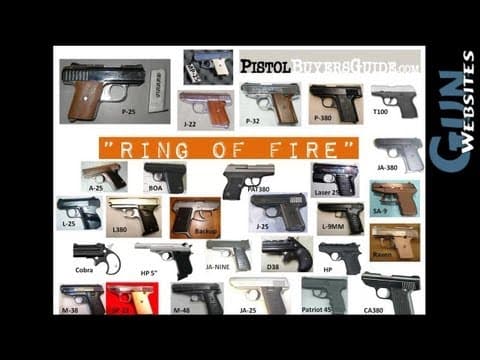
This blog post delves into the history and impact of inexpensive pocket pistols manufactured in the Los Angeles area, known as the Ring of Fire. It covers the origins of these firearms, the companies involved, the legal landscape surrounding them, and their portrayal in the media, ultimately highlighting their complex legacy in American firearms history.
Today, we will discuss a specific category of firearms: inexpensive pocket pistols manufactured in the Los Angeles area. These handguns, often seen as villains in mass media portrayals of firearms and crime, have a rich and complicated history that deserves exploration.
The story of inexpensive pocket pistols begins with the legendary John Moses Browning, who invented the .25 ACP cartridge and the vest pocket pistols at the turn of the last century. In 1905, Browning created the FN model 1906 and the Colt model 1908, both of which became popular pocket pistols. These firearms were designed to meet a demand for small, easily concealable weapons and have been in production for over a century.
A significant turning point in the history of firearms in the United States was the passage of the Gun Control Act (GCA) in 1968. This legislation established federal regulations for the firearms industry, including the requirement for serial numbers, restrictions on ownership, and the introduction of the Federal Firearms License (FFL) system. Notably, the GCA also included importation guidelines that made it increasingly difficult for small caliber pocket pistols to be imported into the U.S.
The GCA's restrictions led to a decrease in the supply of small pocket pistols in the U.S. market. The term "Saturday Night Specials" was coined in the 1960s to describe low-cost, small-caliber firearms that became the target of anti-gun organizations and mainstream media. These firearms, often produced in Los Angeles, were characterized by their affordability and simplicity, but they did not receive much respect from firearms enthusiasts.
The term "Ring of Fire" refers to a group of firearms manufacturers located within an hour of downtown Los Angeles. The phrase was popularized by an emergency room doctor and anti-gun advocate who was concerned about the proliferation of these manufacturers. The following companies are key players in the Ring of Fire:
Founded in 1970 by George Jennings, Raven Arms produced the Raven P25, a .25 ACP pocket pistol that became the cornerstone of the Ring of Fire. The company thrived in the market for inexpensive firearms.
In 1978, George Jennings' son, Bruce, left Raven Arms to establish Jennings Firearms. Bruce designed a smaller pistol based on the Raven P25, scaled down for the .22 Long Rifle cartridge.
In 1982, George Jennings' daughter, Gail, and his office manager, Jim Davis, founded Davis Industries. They created a scaled-up version of the Raven P25 for the .32 ACP and .380 ACP cartridges.
The relationships among the Ring of Fire manufacturers are intricate, with many companies sharing founders, designs, and market strategies. For instance, Bruce Jennings' divorce led to the creation of Braco Arms, while his nephew, Steven Jennings, founded Sundance Industries. The interconnectedness of these companies illustrates a unique family business structure that has been described as inbreeding or collusion.
The portrayal of Ring of Fire firearms in the media has significantly influenced public perception. Articles from the early 1990s, particularly by journalist Alex Fredman, highlighted concerns about the proliferation of inexpensive, easily concealable firearms. These reports, along with a 1994 research paper by Dr. Garen Wintemute, contributed to the negative reputation of these firearms.
One of the most dramatic aspects of the Ring of Fire's history involves legal battles. A notable case is that of Brandon Maxfield, who was paralyzed after being accidentally shot by a babysitter using a Braco pistol. The resulting lawsuit led to a record $24 million judgment against Braco Arms, which ultimately contributed to the company's bankruptcy.
The legacy of inexpensive pocket pistols, particularly those produced by the Ring of Fire manufacturers, is complex and multifaceted. While they have often been vilified in media narratives, it is essential to recognize the historical context, legal challenges, and market dynamics that have shaped their existence. As we reflect on this aspect of firearms history, it is crucial to engage in informed discussions about the implications of regulation and the rights of manufacturers and consumers alike. The Ring of Fire serves as a reminder of the intricate interplay between legislation, public perception, and the firearms industry.