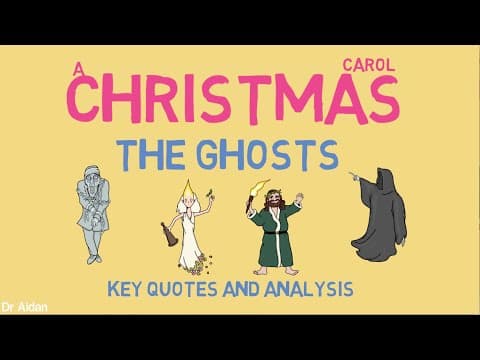
This blog post analyzes the four ghosts in Charles Dickens' A Christmas Carol, detailing their unique roles in Scrooge's transformation from a miser to a generous man. Each ghost embodies different themes, from fear and memory to generosity and the inevitability of death, ultimately guiding Scrooge towards redemption.
In Charles Dickens' timeless novella, A Christmas Carol, the ghosts play a pivotal role in the transformation of Ebenezer Scrooge from a miserly, selfish man to one filled with generosity and compassion. This analysis delves into how each ghost is presented, their distinct roles, and the key quotes that encapsulate their significance.
The first ghost that Scrooge encounters is that of Jacob Marley, his former business partner. Marley’s ghost aims to instill fear in Scrooge regarding the consequences of his actions in life. Dickens describes Marley’s ghost with an unsettling image:
"For though the ghost was perfectly motionless, its hair and skirts and tassels were still agitated as by the hot vapor from an oven."
This contradictory imagery conveys a sense of unease, suggesting that something is amiss.
What ultimately convinces Scrooge of the ghost's reality is a more mundane yet chilling act:
"The phantom taking off the bandage around its head... its lower jaw dropped down upon its breast."
This detail resonates with Victorian customs surrounding death, where fabric was used to keep the jaws of the deceased closed. This personal connection forces Scrooge to confront the reality of Marley’s ghost.
Marley reveals the burden of his own greed, stating that he must wander the earth, witnessing what he could have shared with others. The imagery of the chains he bears—"cash boxes, keys, padlocks, ledger's deeds, and heavy purses wrought in steel"—symbolizes how wealth can become a burden if not used to bring happiness to others.
The second spirit, the Ghost of Christmas Past, represents memory and serves to illuminate Scrooge's forgotten experiences. This ghost is characterized by contradictions:
"It was both old and young... its hair was white as if with age and yet the face had not a wrinkle in it."
This duality emphasizes that our past shapes our present.
The ghost carries a light that symbolizes enlightenment, guiding Scrooge to confront his past choices. The juxtaposition of elements, such as the branch of fresh green holly and summer flowers, illustrates the blend of joy and sorrow in Scrooge's memories. The ghost’s role is to remind Scrooge of the impact of his past decisions on his current life.
The third spirit, the Ghost of Christmas Present, embodies generosity and the joy of sharing. Dickens describes this ghost as a "jolly giant" who bears a glowing torch, linking the concepts of brightness and warmth. The imagery of the cornucopia, or Plentiful Horn, reinforces the theme of abundance:
"The walls and the ceiling were so hung with living green they looked a perfect grove."
This vibrant depiction symbolizes the richness of life that comes from generosity.
The ghost’s open coat and bare feet signify openness and naturalness, suggesting that true happiness comes from sharing with others. The adjectives used to describe the ghost—"genial," "sparkling," and "cheery"—further emphasize the warmth and joy that generosity brings, not only to others but also to oneself.
The final spirit, the Ghost of Christmas Yet to Come, represents death and the inevitable fate that awaits everyone. This ghost is introduced as a solemn phantom, draped and hooded, evoking a sense of dread:
"It seemed to scatter gloom and mystery."
The use of the word "phantom" carries a more sinister connotation than "ghost," suggesting a deeper fear.
The atmosphere surrounding this ghost is starkly different from the previous spirits, filled with melancholy and mystery. Scrooge is filled with dread as he is shown a future devoid of care and compassion, where his death goes unnoticed. The scenes depicted are uniformly unhappy, reinforcing the consequences of a life lived without generosity.
In summary, Dickens masterfully presents the four ghosts in A Christmas Carol to evoke different emotions and themes. Marley’s ghost instills fear of the afterlife, the Ghost of Christmas Past awakens reflection on personal history, the Ghost of Christmas Present embodies the joy of sharing, and the Ghost of Christmas Yet to Come confronts Scrooge with the reality of death. Together, these spirits guide Scrooge towards redemption, prompting him to embrace a future filled with generosity and compassion.
As you read this novella, pay attention to these features and the profound messages they convey about life, death, and the importance of human connection.