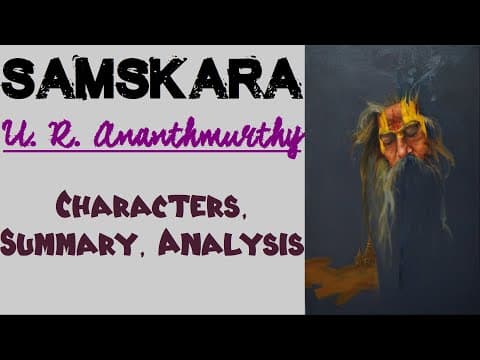
This blog post delves into U. R. Ananthamurthy's novel 'Samskara', exploring its characters, themes, and the clash between tradition and modernity in the context of Brahminical culture and social issues in India.
'Samskara: The Right for a Dead Man' is a profound novel by Indian author U. R. Ananthamurthy, first published in 1965. Originally written in Kannada, it was later translated into English by renowned poet A. K. Ramanujan in 1976. The novel not only critiques Brahminical cultural dominance but also exposes the religious hypocrisy prevalent in society. Through its narrative, it raises critical questions about social issues such as untouchability, casteism, ritualism, and the disintegration of the Hindu community.
The novel is rich with complex characters, each representing different facets of society and its traditions:
Narappa is the deceased character around whom the story revolves. A member of the Brahmin community in the fictional village of Durvasa Pura, he is notorious for his disregard for Brahmin traditions. His lifestyle choices, including leaving his wife for a lower-caste woman, indulging in alcohol and meat, and openly mocking religious customs, create a significant uproar upon his death. The community struggles to decide how to handle his funeral rites, reflecting their internal conflicts regarding tradition and morality.
Pranesh Aara is a respected scholar within the Brahmin community. He is depicted as a kind man, devoted to caring for his ill wife, Bhakti. His character embodies the struggle between adhering to religious duties and confronting personal desires. As the community turns to him for guidance regarding Narappa's funeral, he grapples with the implications of his decisions, revealing the tension between tradition and modernity.
Chandri, a former prostitute, is Narappa's lover. Despite Narappa's poor treatment of her, she shows unwavering care for him, even after his death. Her character challenges societal norms and highlights the complexities of love and loyalty across caste lines. She plays a crucial role in advocating for Narappa's funeral rites, pushing for him to receive the respect traditionally afforded to Brahmins.
Gura is Narappa's greedy relative, focused on claiming Narappa's wealth rather than performing his last rites. Lakana, another relative, engages in disputes with Gura over Narappa's property, showcasing the selfishness and moral decay within the community.
Puta is a man Pranesh Aara encounters in the forest, representing the temptations of a life of indulgence. He tries to corrupt Pranesh Aara with the same habits that led to Narappa's downfall. Padmavati, a beautiful woman and friend of Puta, attempts to seduce Pranesh Aara, further complicating his internal struggle between desire and duty.
Shripati is a young Brahmin who perceives the elders of the community as foolish and out of touch. His affair with a low-caste girl, Belly, exemplifies the exploitation and moral contradictions present in the society depicted in the novel.
Set in the small village of Durvasa Pura, the narrative follows Pranesh Aara, a scholar who has mastered the Vedic scriptures. He marries Bhakti, an invalid woman, ostensibly to fulfill his religious duties and achieve spiritual readiness. However, his marriage is also a means to avoid sensual pleasures.
The story unfolds with the news of Narappa's death, prompting the Brahmin community to confront the question of his funeral rites. Pranesh Aara is tasked with deciding whether Narappa, who lived a life contrary to Brahmin values, deserves a proper burial. The community's reluctance to honor Narappa reflects their internalized hypocrisy and the rigid adherence to tradition.
As Pranesh Aara navigates the complexities of his relationships with Chandri, Gura, and Lakana, he becomes increasingly tormented by his desires and the expectations placed upon him. His eventual affair with Chandri symbolizes his struggle against societal norms and his own moral dilemmas.
The novel culminates in Pranesh Aara's realization of his own failings and the weight of his decisions, leaving readers to ponder the implications of tradition, morality, and the human condition.
'Samskara' is a powerful exploration of the clash between tradition and modernity, highlighting the complexities of human relationships within the rigid framework of Brahminical society. Ananthamurthy's characters serve as vehicles for examining deep-rooted social issues, making the novel a significant contribution to Indian literature. Through its rich narrative and profound themes, 'Samskara' invites readers to reflect on the nature of morality, identity, and the societal constructs that shape our lives.