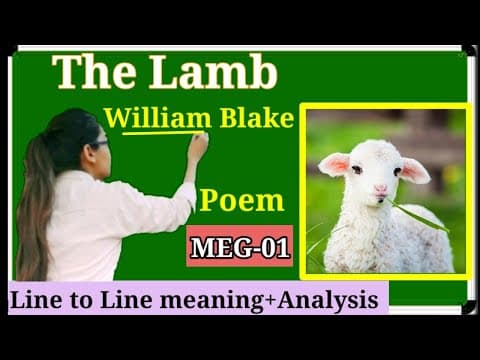
This blog post provides a detailed line-by-line explanation of William Blake's poem 'The Lamb' from his collection 'Songs of Innocence', discussing its themes, structure, and the poet's background.
In this blog post, we will delve into the poem "The Lamb" written by William Blake. We will explore the poet's background, the themes of the poem, and provide a detailed line-by-line explanation.
William Blake was a prominent English poet and artist, born in London on November 28, 1757. He is often regarded as one of the most significant figures in the Romantic movement. Blake's work is characterized by its mystical and visionary qualities, and he is known for his unique style that combines poetry and visual art.
Blake married Catherine Boucher, who played a crucial role in his life by teaching him to read and write, as well as assisting him in his artistic endeavors. Throughout his career, Blake worked as an engraver and illustrator, producing works that were often met with mixed reviews during his lifetime. He faced personal tragedies, including the death of his daughter, which deeply affected him.
"The Lamb" is part of Blake's collection titled "Songs of Innocence," published in 1789. This collection portrays the innocence and purity of childhood, contrasting with the experiences of adulthood found in his later work, "Songs of Experience." "The Lamb" serves as a tribute to the innocence of children and the divine creation of life.
The poem begins with a child speaking to a lamb, asking it a series of questions. This dialogue format sets the stage for a conversation about creation and innocence.
The opening lines introduce the child, who asks the lamb, "Little Lamb, who made thee?" This question reflects the child's innocence and curiosity about the origins of life. The repetition of the question emphasizes the child's desire to understand who created the lamb and, by extension, all living beings.
As the child continues, he inquires about the lamb's life, asking who provided it with food and clothing. The child expresses wonder at the lamb's existence, highlighting the themes of nurturing and care in creation. The imagery of soft clothing and gentle voice evokes a sense of tenderness and purity.
The child’s repeated questioning signifies a deep yearning for knowledge and understanding. The innocence of the child is mirrored in the lamb, symbolizing purity and the divine nature of creation. The child perceives the lamb as a reflection of himself, both innocent and cherished.
In the latter part of the poem, the child answers his own questions, revealing that the creator of the lamb is also a divine figure. The child identifies the lamb with Jesus Christ, emphasizing the connection between innocence and divinity. This revelation serves as a profound moment in the poem, linking the themes of childhood innocence with spiritual purity.
The poem concludes with the child blessing the lamb, saying, "God bless thee!" This final line encapsulates the essence of the poem, celebrating the beauty of creation and the innocence of childhood. The dialogue between the child and the lamb serves as a metaphor for the relationship between humanity and the divine.
The primary theme of "The Lamb" is innocence. The child’s questions and the lamb’s gentle nature symbolize the purity of childhood. Blake uses the lamb as a symbol of innocence, representing the untainted spirit of children.
The poem also explores the theme of divine creation. The child’s inquiry about the lamb’s origins leads to a deeper understanding of the relationship between the creator and the created. Blake suggests that all life is interconnected and that innocence is a divine gift.
Blake’s use of pastoral imagery reflects a longing for a simpler, more innocent time. The natural setting of the poem enhances the themes of purity and innocence, creating a serene backdrop for the child’s exploration of creation.
William Blake's "The Lamb" is a profound exploration of innocence, creation, and the divine. Through the dialogue between the child and the lamb, Blake invites readers to reflect on the beauty of life and the purity of childhood. The poem serves as a timeless reminder of the importance of nurturing innocence in a world that often challenges it.