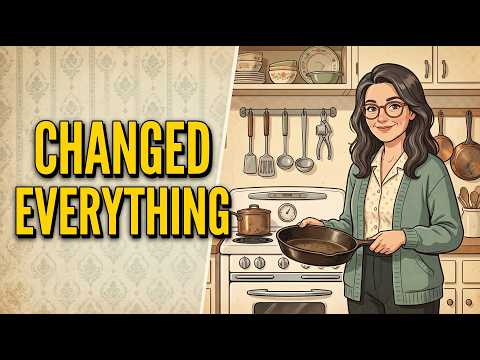
At 52, I revived 12 kitchen habits from my grandmother's era that saved me money, reduced waste, and changed my relationship with food. From weekly meal planning and pantry-first shopping to repurposing scraps for broth and using a bacon grease jar, these practices emphasize resourcefulness and respect for food, proving that the kitchen is a place of creation, not just consumption.
My grandmother's kitchen was tiny—about the size of a parking space. She had just one cast iron skillet, one good knife, and a drawer full of habits that fed six children on a postman's salary. Remarkably, she never once ordered takeout.
When I turned 52, I stood in my own kitchen, which was a stark contrast. I had a drawer full of expensive gadgets I rarely used, a freezer stuffed with forgotten leftovers, and a stack of delivery receipts that would have made her cry.
I decided to go back to the way she ran her kitchen. This single decision has saved me more money than anything else I have ever done. Here, I share the 12 kitchen habits from my grandmother's era that I have personally brought back into my life at 52.
Every Sunday after supper, my grandmother would sit at her kitchen table with a pencil and a scrap of paper to plan every meal for the upcoming week—breakfast, lunch, and dinner. She pinned that paper inside her kitchen cabinet door, so there was never a question about what was for dinner or a panicked trip to the store for missing ingredients.
Today, many of us stand in front of the refrigerator at 6 p.m., blank, scrolling through recipes on our phones for 20 minutes before giving up and ordering expensive takeout.
When I started planning my meals every Sunday evening, my monthly grocery bill dropped by nearly $300 because I bought exactly what I needed—no food waste, no emergency takeout, no impulse purchases. That’s $3,600 a year for just 20 minutes of planning.
My grandmother never looked at a recipe and then went shopping. Instead, she opened her pantry and icebox, looked at what she already had, and built meals around those ingredients.
Today, we often do the opposite—find a recipe online, then buy $30 worth of ingredients we use once and never touch again. This leads to half-used bottles and spices that go to waste.
By cooking pantry-first, my grocery trips became shorter, cheaper, and far less wasteful. I buy staples in bulk and build meals around what I already own.
In the 1950s, energy was expensive, so turning on the oven was not taken lightly. My grandmother had a strict rule: if the oven is on, it must be full. She would roast a chicken and slide potatoes, cornbread, or even a dessert in alongside it—one heating cycle, three results.
Today, we preheat an entire oven to bake a single tray of frozen chicken nuggets, heating 4 cubic feet of air for just 12 nuggets.
When I started filling my oven every time I turned it on, my electric bill dropped, and I always had extra cooked food ready for the next day.
My grandmother never served plain hamburger patties. She stretched every pound of ground beef by mixing in oats, breadcrumbs, grated carrots, and chopped onions. A single pound became enough for a family of eight.
The patties were just as filling and more flavorful, going three times as far. She did the same with meatloaf, casseroles, and meat sauces—the meat was the flavor, fillers were the volume.
Today, a pound of ground beef costs $6 or more. Adding oats and vegetables made that pound feed my household for two full dinners instead of one.
In my grandmother's kitchen, stale bread was never garbage. It was an ingredient—used for French toast, breadcrumbs, bread pudding, or soaked in milk and folded into meatloaf.
The average American household throws away roughly $1,300 worth of food annually, much of it stale bread.
I have not thrown away a single piece of bread in over a year. When bread starts to go stale, it goes straight into a freezer bag. When full, I make breadcrumbs in my blender in 30 seconds.
Every 1950s kitchen had a small glass jar next to the stove for bacon grease. My grandmother poured hot bacon drippings into this jar through a strainer and never threw it away.
This rendered bacon fat became her primary cooking oil—used for frying eggs, sautéing vegetables, seasoning cast iron, and even spreading on toast. It was free and added incredible flavor, replacing expensive cooking oils.
I started keeping a bacon grease jar 8 months ago and now use far less cooking oil. Eggs fried in bacon grease are a completely different experience.
Kitchens in the 1950s were designed around the work triangle—the stove, sink, and refrigerator placed in a tight triangle to minimize steps.
My grandmother applied this principle to everything in her kitchen. Every tool, ingredient, and pot had a specific permanent home. She could cook an entire dinner practically with her eyes closed because she never had to search for anything.
Today, many people spend 10 to 15 minutes just looking for things before cooking. After reorganizing my kitchen so every tool was within arm’s reach of where I used it, my cooking time dropped by almost half.
In my grandmother's house, once dinner dishes were washed and put away, the kitchen was closed for the day. Nobody snacked late at night or rummaged through the pantry at midnight.
Today, kitchens are treated like 24-hour convenience stores, leading to constant snacking and faster grocery depletion.
When I started closing my kitchen at 7:30 p.m., my grocery bill went down because I stopped eating a second dinner’s worth of snacks, and I started sleeping better because I wasn’t going to bed on a full stomach.
My grandmother had one cast iron skillet that she cooked everything in—eggs, cornbread, fried chicken, even pie. It was given to her by her mother and still works perfectly today.
Today, we buy cheap nonstick pans for $15 that peel after six months, then throw them away and buy new ones. Over 10 years, that adds up to $150 on disposable cookware.
I invested in three quality pieces—a cast iron skillet, a heavy Dutch oven, and a good chef’s knife. Two years later, I haven’t bought any cookware since, and everything I cook tastes better.
My grandmother never bought Tupperware. She washed and reused every jar from jam, pickles, or sauce, removing labels and storing flour, sugar, rice, dried beans, leftover soup, bacon grease, and homemade dressings.
Today, we spend $30 to $50 on plastic container sets that lose lids or stain quickly.
I stopped buying plastic containers entirely. Every jar that comes into my kitchen gets washed and reused. My pantry looks beautiful, costs nothing, and unlike plastic, glass does not stain, warp, or absorb odors.
This habit separates my grandmother’s generation from ours. She kept a large freezer bag in her freezer for scraps—carrot peelings, onion skins, celery ends, chicken bones, leftover herbs.
When full, she dumped the bag into her largest pot, covered it with water, and simmered it for 3-4 hours. After straining, she had quarts of rich, flavorful homemade broth made entirely from scraps that would otherwise be trash.
Store-bought broth costs $3 to $4 per carton. Making soup twice a week costs $30 a month. My grandmother made better broth for free.
I’ve been doing this for over a year. The bag fills every 10 days, producing about eight cups of broth richer and more flavorful than anything store-bought.
My grandmother didn’t see her kitchen as just a place to prepare food but as a place to transform things. Scraps were ingredients, stale bread was tomorrow’s breakfast, bones were next week’s soup.
Every item was used to its absolute limit before leaving the kitchen. Nothing was discarded until every last bit of value was extracted.
This philosophy was not just a saying but a moral code. Throwing away perfectly good food was shameful and a failure of imagination.
When I adopted this mindset at 52, the change was financial and emotional. I stopped feeling overwhelmed by my kitchen and dreading cooking because I was transforming what I already had.
Leftovers became a head start on tomorrow, and my relationship with food, money, and home shifted in ways I never expected.
My grandmother understood what most of us have forgotten: the kitchen is not a place of consumption but a place of creation. When you treat it that way, everything changes.
These 12 kitchen habits from my grandmother’s era have genuinely changed my life at 52. When I told my mother I was keeping a bacon grease jar on my counter, she laughed and said I was turning into my grandmother. That was the best compliment I’ve ever received.
Which of these kitchen habits will you bring back? Did your grandmother or mother have a kitchen trick I missed? Share your thoughts and stories—these timeless habits are worth reviving.