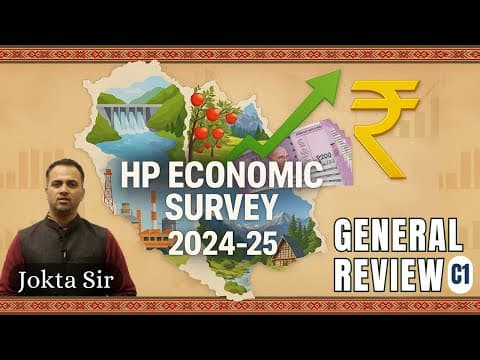
This blog post provides a detailed overview of the HP Economic Survey 2024-25, discussing the differences between the economic survey and the budget, global and Indian economic growth rates, and specific insights into Himachal Pradesh's economy, including sector-wise contributions and growth projections.
The Himachal Pradesh Economic Survey is a crucial document that aids in preparation for various competitive exams, including HPAS, NT, and allied services. This blog post aims to provide a structured overview of the first chapter of the Economic Survey 2024-25, focusing on the general review of the economy.
The Economic Survey serves as a foundational document that outlines the economic performance and projections for the state. It is essential for candidates preparing for prelims and interviews, as it compiles significant data and facts that can be utilized in various examinations. The survey is released annually, and this year, we will also be providing a series of videos to help candidates understand how to effectively study the survey and retain important data.
A key distinction between the Economic Survey and the budget is their focus and timing. The Economic Survey for 2024-25 reflects on the achievements and performance of the previous year, while the budget for 2025-26 sets targets for the upcoming year. The budget outlines goals to be achieved from January to December, with results typically visible in the following year. In contrast, the Economic Survey reviews past performance and assesses how well the targets set for the previous year were met.
The global economy has shown modest growth, with the International Monetary Fund reporting a growth rate of 3.3% in 2023 and a slight decline to 3.2% in 2024. Projections for 2025 and 2026 suggest a return to 3.3%. This indicates a relatively stagnant global economic outlook, with expectations that the global GDP growth will remain around 3.1% until 2029.
India has been ranked fifth in the world in terms of GDP. The current nominal GDP of India stands at approximately $3.59 trillion, with a target to reach $5 trillion. The growth rates for India are promising, with projections of 6.8% for 2024, 6.9% for 2025, and 6.8% for 2026. This positions India as one of the fastest-growing economies globally, especially when compared to other major economies like Russia, which is projected to grow at only 0.9%.
India's economy is categorized into three sectors: primary, secondary, and tertiary. The growth rates for these sectors are as follows:
The tertiary sector, which includes services, is showing the highest growth, indicating a shift in the economic structure towards service-oriented industries.
Himachal Pradesh's economy is also undergoing significant changes. The revised estimates of the Gross State Domestic Product (GSDP) indicate a growth rate of 9.9% at current prices and 6.6% at constant prices. The per capita income in Himachal Pradesh is estimated at ₹234,782, reflecting a growth of 9.5%.
The primary sector continues to be a significant source of employment in Himachal Pradesh, providing jobs to approximately 53.98% of the workforce. However, unemployment rates, particularly among urban youth, have been a concern, highlighting the need for job creation in other sectors.
The contribution of various sectors to the GSDP has shifted over the years:
This shift indicates a transformation in the economic landscape of Himachal Pradesh, moving from agriculture to industry and services.
The first chapter of the HP Economic Survey 2024-25 provides a comprehensive overview of the economic landscape, highlighting the differences between the Economic Survey and the budget, global economic trends, and specific insights into Himachal Pradesh's economy. As we continue this series, it is essential for candidates to keep a notebook handy for additional notes and to engage with the material actively. Understanding these economic dynamics will not only aid in exam preparation but also provide a clearer picture of the state's economic trajectory.