Contrary to common Western narratives of Iranian weakness, Iran has demonstrated resilience and strategic influence, establishing itself as a world power. Its control over critical regions like the Straits of Hormuz and ability to challenge American and Israeli military objectives highlight a shift in global power dynamics from 20th-century metrics to 21st-century realities, marking Iran as a key player in a multipolar world.
When listening to American pundits and leaders on national television, one might get the impression that Iran is on the brink of collapse, barely holding on, and that the United States could easily intervene and emerge victorious. However, a closer examination of the realities on the ground paints a very different picture.
The prevailing narrative in much of Western media suggests that Iran is weak and vulnerable. This perspective often assumes that Iran is just "hanging on" and that any day it might collapse under pressure from the United States or its allies. Yet, this narrative does not align with the actual fundamentals observed in the region.
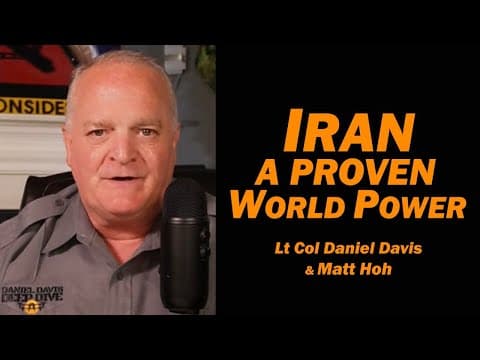
Matthew Hoh, a former State Department official and combat Marine, recently articulated a bold statement: Iran is now a proven world power. This assertion challenges the conventional wisdom that Iran is a minor player or a country on the verge of defeat.
Iran has demonstrated the ability to confront both the American military and Israel in a conflict that many have anticipated for decades. Far from being defeated, Iran has not only survived but has maintained control over critical strategic points, most notably the Straits of Hormuz.
Despite various claims and bluster, including statements from former President Donald Trump about mine-sweeping operations, the reality is that Iran controls the Straits of Hormuz now and likely will continue to do so indefinitely. This control is a significant strategic advantage, given the straits' importance for global oil transportation.
The conflict involving Iran is often described as a war between the 20th century and the 21st century. It pits the American imperial order, often referred to as the American century, against a multipolar world order.
Traditional measures of world power—such as military size, nominal GDP, and nuclear arsenal—are increasingly outdated. In the 21st century, technology, resource dependencies, and strategic influence play a more critical role.
Iran exemplifies this new paradigm. Despite not having the largest military or economy, Iran exerts significant influence globally. Its ability to impact international affairs, dictate terms in critical regions, and maintain resilience against powerful adversaries qualifies it as a world power by any reasonable definition.
Some analysts now recognize four world powers: the United States, Russia, China, and Iran. This recognition is controversial and challenges long-held assumptions about global power hierarchies.
For decades, Iran was perceived as a "little guy" that could be easily pressured or controlled. The United States and Israel have taken numerous actions against Iran, including:
Despite these efforts, Iran has not been subdued. Instead, it has demonstrated an ability to absorb these blows and continue to assert itself regionally and globally.
Iran’s leadership has shown remarkable strategic acumen. Their ability to navigate complex geopolitical challenges and maintain influence over critical regions is a testament to their resilience and strategic vision.
This leadership contrasts with the often reactive and fragmented approach seen in some Western powers. Iran’s capacity to adapt and control key strategic points, such as the Straits of Hormuz, underscores its status as a formidable global actor.
The narrative of Iranian weakness is not supported by the facts on the ground. Iran has emerged as a proven world power, capable of challenging traditional global powers and reshaping the geopolitical landscape.
Its control over strategic regions, resilience in the face of military and covert attacks, and ability to influence global affairs mark a significant shift in the understanding of world power in the 21st century.
As the global order continues to evolve, recognizing Iran’s role as a key player is essential for a realistic and informed perspective on international relations and future conflicts.