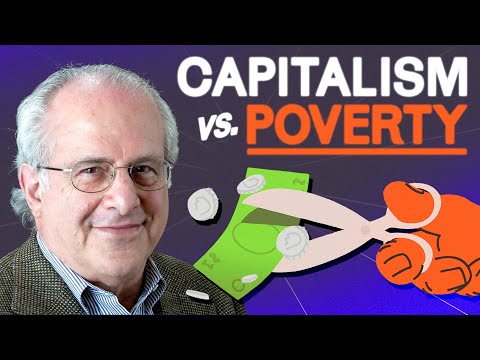
This blog post critically examines the claim that capitalism has significantly reduced poverty, arguing that the reality is more complex. It highlights the arbitrary definitions of poverty, the role of government intervention in poverty reduction, and the systemic flaws of capitalism that contribute to ongoing poverty.
The assertion that capitalism has lifted millions out of poverty is a common refrain in discussions about economic systems. Proponents often cite dramatic reductions in extreme poverty rates as evidence of capitalism's success. However, this perspective warrants a closer examination, particularly in light of the complexities surrounding poverty definitions and the actual impacts of capitalist policies.
Many advocates of capitalism argue that global capitalism has drastically reduced poverty, claiming reductions of up to 80% or 90%. This narrative often echoes sentiments from personal anecdotes, such as a mother reminding her child to appreciate improvements over time. Yet, this perspective can overlook critical nuances in the data and the lived experiences of those still facing poverty.
The World Bank defines poverty as living on less than $1.90 a day. This figure, however, is not grounded in the actual living costs faced by individuals. Critics argue that this threshold is arbitrary and unrealistic. For instance, the United Nations suggests that a minimum of $7.40 a day is necessary for basic nutrition and a normal life expectancy. Using this more realistic benchmark, the number of people living in poverty has actually increased over the past four decades, reaching approximately 4.2 billion individuals.
While proponents of capitalism may point to declining poverty rates, it is essential to consider the context. Much of the global reduction in poverty can be attributed to one country: China. China's approach, characterized by significant government industrial spending and social programs labeled as "socialist," has led to substantial poverty alleviation. In contrast, countries that adopted American-style capitalism have seen minimal progress in reducing poverty.
Excluding China from the equation reveals a stark reality: not only has the number of people in poverty increased, but the proportion of people living in poverty has only marginally decreased—by a mere 5.4% over 40 years. Experts project that at this rate, it would take over 200 years to eliminate poverty, assuming no economic recessions and a massive expansion of the global economy. The recent COVID-19 pandemic has further exacerbated this issue, pushing an additional 100 million people back into extreme poverty.
The underlying problem is not merely external shocks like pandemics but the systemic flaws inherent in capitalism itself. The capitalist system tends to experience crises every four to seven years, which disproportionately affects ordinary people and pushes them into deeper poverty. Even defenders of capitalism are beginning to acknowledge these flaws. The World Bank has indicated that reducing inequality by just 1% annually could lift more people out of poverty than increasing economic growth by the same percentage.
While some aspects of life have improved under capitalism, these advancements are often the result of ambitious government programs rather than capitalist policies. For example, Cuba, despite being under a long-standing embargo, boasts lower infant mortality rates, higher life expectancy, and greater literacy rates than the wealthier United States. Similarly, countries like Denmark and Finland, known for their high levels of government social spending, report the lowest poverty rates.
Historically, capitalists have resisted policies aimed at reducing poverty, such as progressive taxation, minimum wage laws, social welfare programs, and union bargaining. This opposition suggests that poverty reduction has occurred not because of capitalism, but rather in spite of it. The rising number of individuals living in poverty serves as a testament to the inadequacies of a profit-driven system.
In conclusion, the narrative that capitalism is effectively reducing poverty is overly simplistic and often misleading. The reality is that poverty persists and even grows under a capitalist framework, primarily due to systemic flaws and a lack of adequate government intervention. As long as economic systems prioritize profit over people, the struggle against poverty will continue, challenging the notion that capitalism is the solution to this enduring issue.





