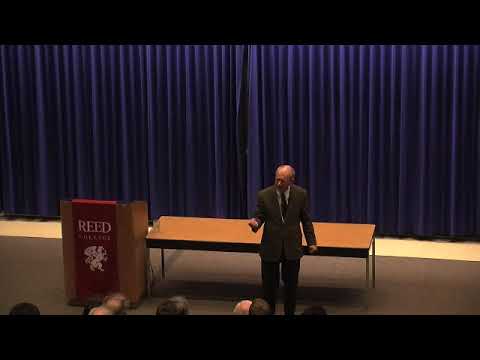
John J. Mearsheimer discusses the implications of China's rise in global power, questioning whether it can do so peacefully. He outlines a theory of great power politics, emphasizing the competitive nature of international relations and the inevitability of conflict as states seek to maximize their power and security. Mearsheimer argues that the U.S. will likely resist China's rise, leading to increased tensions and potential conflict in Asia.
In a recent talk, John J. Mearsheimer addressed the critical question of whether China can rise peacefully in the global arena. He began by outlining two fundamental questions regarding China's future: 1) Will China continue its impressive rise over the next few decades? 2) If it does rise, can it do so without conflict? Mearsheimer expressed his agnosticism about the first question but emphasized the importance of the second, which he believes is crucial for the United States and China's neighbors.
Mearsheimer argues that to answer whether China can rise peacefully, we must rely on a theoretical framework, as we lack concrete facts about the future. He proposes a theory of great power politics based on five key assumptions:
From these assumptions, Mearsheimer concludes that states operate in a competitive environment where fear, self-help, and the desire for power dominate behavior. This leads to the conclusion that states will strive to be the most powerful in their region, a concept he refers to as regional hegemony.
Mearsheimer then provides a synoptic overview of American foreign policy since 1783, illustrating how it aligns with his theory. He argues that the U.S. has consistently sought to establish regional hegemony and prevent the emergence of peer competitors. Key historical examples include:
These actions demonstrate a consistent pattern of behavior that aligns with Mearsheimer's theory of great power politics.
Assuming that China continues to grow economically, Mearsheimer argues that it will inevitably seek to dominate Asia, driven by historical grievances from the "century of national humiliation." He posits that China will likely adopt a Monroe Doctrine-like approach, aiming to push the U.S. out of its sphere of influence in East Asia. This desire for regional dominance will lead to increased tensions with the U.S. and its allies.
Mearsheimer emphasizes that as China grows, it will translate its economic power into military might, leading to a security competition reminiscent of the Cold War. He notes that the U.S. and its allies, including Japan and India, are already forming a balancing coalition against China, reflecting widespread concern about its rise.
A significant aspect of Mearsheimer's argument is the security dilemma, where actions taken by one state for defensive purposes are perceived as offensive by another. This dynamic can lead to an arms race and increase the likelihood of conflict. For instance, the U.S. pivot to Asia is seen by China as a threat, prompting it to bolster its military capabilities, which in turn heightens U.S. concerns.
Mearsheimer concludes by reiterating the limitations of social science theories, acknowledging that while his theory may not explain every situation perfectly, it provides a framework for understanding the competitive nature of international relations. He expresses hope that the rise of China will fall into the 25% of cases where his theory does not apply, allowing for a peaceful coexistence. However, he remains skeptical, given the historical patterns of great power behavior.
In summary, Mearsheimer's analysis suggests that while China may have a vested interest in rising peacefully, the competitive nature of international politics, particularly with the U.S. as a dominant power, makes this outcome unlikely. The implications of China's rise will continue to shape global dynamics, with the potential for increased tensions and conflict in the Asia-Pacific region.