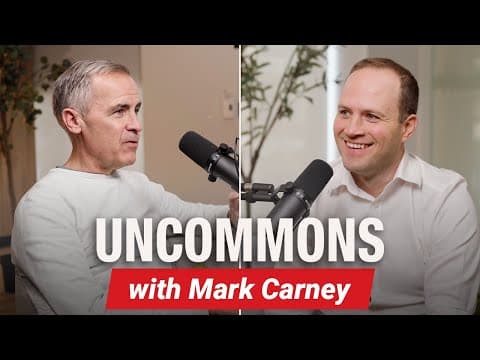
In a recent episode of Uncommons, Mark Carney, former Governor of the Bank of Canada and the Bank of England, discusses the importance of sustainable finance in addressing climate change, the slow progress in Canada, and his potential future in politics as he chairs an economic task force for the Liberal Party.
In a recent episode of Uncommons, host Nat Riskin Smith welcomed Mark Carney, the former Governor of the Bank of Canada and the Bank of England. Carney, who is currently chairing an economic task force for the Liberal Party, shared insights on sustainable finance, climate action, and his evolving role in politics.
Carney emphasized the critical role of sustainable finance in addressing climate change. He explained that sustainable finance is about ensuring that capital flows towards solutions that mitigate climate impacts. He stated, "Success in sustainable finance will be when we can drop the adjective and it just becomes mainstream."
Carney highlighted the progress made since the COP26 conference in Glasgow, where finance was central to discussions on climate action. He noted that over 700 of the world's largest financial institutions, controlling more than $150 trillion in assets, are committed to transitioning towards net-zero emissions. However, he expressed frustration with the slow pace of progress in Canada, particularly regarding the establishment of a disclosure regime that would allow Canadians to assess which institutions are genuinely contributing to climate solutions.
Reflecting on Canada's situation, Carney pointed out that while some institutions are voluntarily adopting sustainable practices, a mandatory framework is necessary for all. He stressed the importance of having a clear transition plan for financial institutions to follow, stating, "You cannot get your way out of a situation without a plan."
Carney discussed the environmental, social, and governance (ESG) criteria, focusing on the environmental aspect. He noted that while ESG has potential, companies often prioritize their bottom line over sustainability. He believes that the market must reflect the values of Canadians, who increasingly demand action on climate change.
Carney acknowledged the political challenges in advancing sustainable finance, especially with the potential for a government that may not prioritize climate action. He expressed concern about the backsliding that could occur if political will diminishes. Despite these challenges, he remains optimistic about the potential for change, emphasizing the need for a strong coalition of support from both the public and private sectors.
As Carney engages more deeply in politics, he shared his motivations for joining the Liberal Party's economic task force. He believes in giving back to a country that has provided him with so much and sees an opportunity to influence economic policy positively. He stated, "This country has given me so much... I owe it a lot."
Carney is aware of the challenges that come with entering partisan politics, including potential attacks and criticisms. He expressed readiness to face these challenges, stating, "I know what I'd be getting into. I know what I'm in it now."
Carney's focus on the economic task force is to address productivity and growth in Canada. He highlighted the need for a comprehensive strategy that includes investment in clean energy, technology, and infrastructure. He believes that Canada has the potential to become a clean energy superpower, leveraging its natural resources and expertise in technology.
In discussing inclusive growth, Carney emphasized the importance of ensuring that all Canadians benefit from economic progress. He acknowledged the disparities in wealth and income inequality and stressed the need for policies that support those left behind in the transition to a greener economy.
Mark Carney's insights into sustainable finance and his political aspirations reflect a commitment to addressing climate change and fostering economic growth in Canada. As he navigates the complexities of politics, his focus remains on building a sustainable future that benefits all Canadians. His journey serves as a reminder of the importance of engaging in the political process to drive meaningful change.