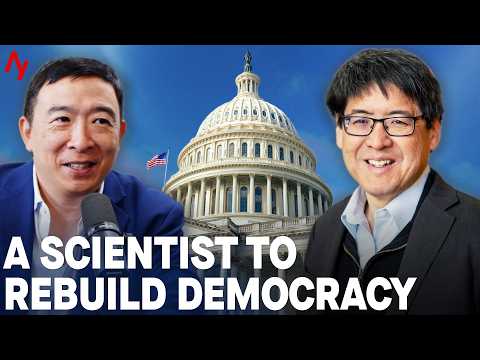
Sam Wang, a Princeton neuroscientist and expert in electoral innovation, is running for Congress in New Jersey's 12th district to improve democracy through science-based reforms. He focuses on addressing issues like gerrymandering, unequal voter influence, and partisan primaries by applying data-driven solutions and promoting electoral reforms such as nonpartisan open primaries and rank-choice voting.
This week on the Andrew Yang podcast, a fascinating conversation unfolds with Sam Wang, a Princeton neuroscientist, professor, and congressional candidate for New Jersey's 12th district. Wang has spent much of his career combining math and law to help people have a greater voice in democracy, focusing on electoral reform and fighting gerrymandering.
Sam Wang's academic journey began with a physics major at Caltech, followed by a PhD in neuroscience at Stanford. His scientific background has been instrumental in his approach to solving problems, particularly in the realm of elections and democracy. Wang has dedicated years to using data, simulations, and mathematical models to analyze and improve the electoral system.
Wang explains that despite his efforts in electoral innovation, progress has been slow, especially given the recent political turmoil. The last year and a half have been described as "a mess," prompting Wang to take his energy off the sidelines and into the political arena by running for Congress. He aims to bring scientific knowledge and practical solutions directly into government.
One of Wang's key concerns has been the unequal influence of voters in the U.S. electoral system. For example, swing state voters in Pennsylvania have significantly more impact on presidential elections than voters in states like New Jersey or New York. Wang's research has quantified this disparity, showing that a single vote in a swing state can be worth thousands of votes elsewhere.
To address this, Wang and his team have used data-driven strategies to direct voter turnout efforts and campaign resources where they can have the most impact. This includes encouraging absentee voting in safe states and mobilizing voters in swing states.
Gerrymandering remains a major obstacle to fair representation. Wang advocates for removing redistricting power from politicians and entrusting it to a jury of regular citizens representing diverse political affiliations. This approach has been shown through research and simulations to increase competition and fairness in elections.
Wang supports reforms such as nonpartisan open primaries and ranked-choice voting. These reforms aim to reduce the dominance of the two-party system and encourage the election of consensus candidates acceptable to a broader range of voters.
Nonpartisan Open Primaries: Instead of separate party primaries, all candidates compete in a single primary, with the top candidates advancing to the general election. This system has been implemented in Alaska and California with positive results.
Ranked-Choice Voting: Voters rank candidates by preference, which helps ensure that winners have broad support and reduces the impact of vote splitting.
These reforms, supported by computer simulations and real-world examples, can help reduce polarization and improve democratic outcomes.
Wang and Andrew Yang discuss the increasing polarization in American politics, where party loyalty often overrides common sense and cooperation. Wang notes that the current system rewards picking a side, making it difficult for independent or moderate voices to thrive.
Yang shares his own experience of leaving the Democratic Party and facing backlash, highlighting the challenges reform-minded candidates face within the entrenched two-party system.
Wang is running in a highly competitive Democratic primary with 13 candidates vying for the seat left open by the retirement of Bonnie Watson Coleman. Despite the crowded field, Wang estimates that winning may require as few as 20,000 votes due to the district's size and voter turnout patterns.
The district is notably diverse, with a majority non-white population and 20% Asian-American residents, which may provide Wang with a unique connection to constituents.
Wang aims to be one of the few scientists in Congress, bringing expertise in biomedical research, machine learning, and data analysis to policymaking. He hopes to improve government functionality, support drug and vaccine development, and apply scientific rigor to legislative challenges.
Running for office has been a significant change for Wang, moving from academic presentations with slides to engaging directly with voters in markets, bakeries, and community events. He shares humorous and heartfelt moments from his campaign trail, including petting dogs and interacting with diverse communities.
Supporters can learn more about Wang and contribute to his campaign at samfornj.org. Endorsements from scientists, Nobel laureates, and community leaders highlight his credibility and potential impact.
Sam Wang's candidacy represents a unique blend of science and public service aimed at fixing democracy through data-driven reforms and inclusive representation. His campaign in New Jersey's 12th district offers a promising example of how expertise and innovation can address the challenges facing American democracy today.
This conversation underscores the importance of electoral reform, the power of science in policymaking, and the potential for new voices to reshape the political landscape for the better.