Alfred Lord Tennyson's poem 'The Charge of the Light Brigade' recounts the tragic military charge during the Crimean War, highlighting the bravery and sacrifice of the soldiers while also critiquing the blunders of their commanders. Through a detailed stanza-by-stanza analysis, the poem's themes of honor, duty, and the consequences of war are explored.
In this article, we will explore Alfred Lord Tennyson's poignant poem, "The Charge of the Light Brigade," which captures the essence of bravery and the tragic consequences of war. Written during the backdrop of the Crimean War in the 1850s, the poem reflects on a disastrous military charge that resulted in the loss of hundreds of British soldiers. We will analyze the poem stanza by stanza, summarizing its key themes and messages.
The Charge of the Light Brigade occurred during the Crimean War, a conflict between Britain and Russia. The Light Brigade, composed of lightly armored cavalry, was tasked with capturing enemy artillery. However, due to a critical miscommunication, they were sent into a deadly situation without adequate preparation or weaponry. This led to significant casualties and a hasty retreat, underscoring the tragic nature of their mission.
Tennyson's poem is both patriotic and critical. It celebrates the courage of the soldiers while lamenting the heavy losses they suffered and the mistakes made by their superiors. The famous line, "someone had blundered," encapsulates the theme of misjudgment that permeates the poem.
"Half a league, half a league, half a league onward,
All in the valley of death rode the six hundred.
Forward, the Light Brigade! Charge for the guns!"
In this opening stanza, we are introduced to the six hundred soldiers of the Light Brigade as they charge into battle. The phrase "valley of death" foreshadows the perilous situation they are entering. The soldiers are depicted as brave and determined, following orders to capture enemy guns despite the imminent danger.
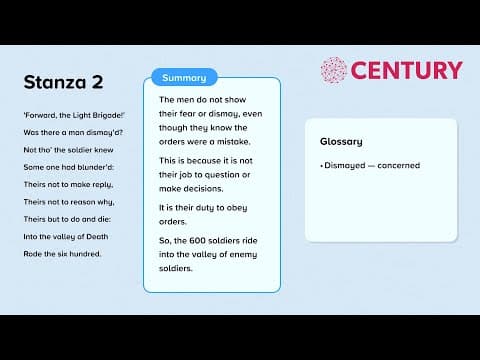
"Was there a man dismayed? Not though the soldier knew
Someone had blundered. Their's not to make reply,
Theirs not to reason why, theirs but to do and die."
Here, Tennyson emphasizes the soldiers' unwavering resolve. Despite knowing that the orders were flawed, they do not express fear or question their mission. Their duty is to obey, highlighting the theme of loyalty and the soldier's code of conduct.
"Cannon to right of them, cannon to left of them,
Cannon in front of them volleyed and thundered;
Storm'd at with shot and shell, boldly they rode and well."
This stanza vividly illustrates the dire circumstances the soldiers face as they are surrounded by enemy cannons. Despite the overwhelming firepower directed at them, the soldiers charge forward with bravery, embodying the spirit of heroism.
"Flashed all their sabres bare, flashed as they turned in air,
Sabring the gunners there, charging an army, while
All the world wondered."
In this stanza, the soldiers engage in combat with their sabres, as they lack firearms. The imagery of their swords flashing in the air symbolizes their courage and determination. The world watches in awe as they confront the enemy, showcasing the dramatic nature of their charge.
"Cannon to right of them, cannon to left of them,
Cannon behind them volleyed and thundered;
Storm'd at with shot and shell, while horse and hero fell."
As the soldiers attempt to retreat, they are still under heavy fire. This stanza highlights the tragic losses they endure, with both soldiers and horses falling in battle. The repetition of the cannons emphasizes the relentless nature of the enemy's assault.
"When can their glory fade? O the wild charge they made!
All the world wondered. Honor the charge they made!
Honor the Light Brigade, noble six hundred!"
In the final stanza, Tennyson reflects on the enduring glory of the soldiers' sacrifice. He poses a rhetorical question about the fading of their honor, suggesting that their bravery will never be forgotten. The call to "honor the Light Brigade" serves as a tribute to their noble actions, despite the tragic outcome.
Alfred Lord Tennyson's "The Charge of the Light Brigade" serves as a powerful reminder of the valor and sacrifice of soldiers in the face of overwhelming odds. Through its vivid imagery and poignant themes, the poem captures the essence of duty, honor, and the tragic consequences of war. As we reflect on the bravery of the Light Brigade, we are reminded of the importance of remembering those who have fought and fallen in battle, honoring their legacy for generations to come.