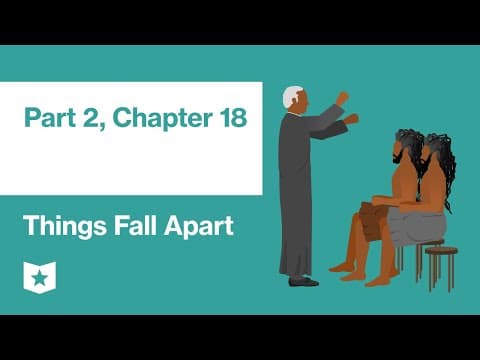
In Chapter 18 of Chinua Achebe's Things Fall Apart, the new church faces challenges as it welcomes outcasts from the village, leading to conflict with traditional beliefs. Okonkwo's desire to expel the Christians contrasts with Mr. Ki Agha's inclusive approach, highlighting the cultural tensions and transformations within the community.
In Part 2, Chapter 18 of Chinua Achebe's seminal work, Things Fall Apart, the narrative delves into the complexities of cultural conflict and transformation within the Igbo community. This chapter illustrates the challenges faced by the new church as it attempts to integrate the village's outcasts, leading to significant tensions among the villagers.
The new church, which has begun to establish itself in the village, takes a progressive stance by welcoming individuals who have been marginalized by society. When two outcasts attend a service, their presence sparks outrage among the congregation. However, Mr. Ki Agha, a key figure in the church, firmly believes in the principle of acceptance, insisting that everyone deserves a place within the community. This inclusive approach, while noble, causes a rift within the congregation, resulting in one member leaving in protest.
Despite the initial backlash, the outcasts who join the church become some of its most fervent supporters. Their newfound faith provides them with a sense of belonging and empowerment, contrasting sharply with their previous societal status.
A pivotal moment in this chapter occurs when a Christian member kills a Python, an animal revered by the Igbo people and referred to as "our Father". This act incites a gathering of the village leaders, who must decide how to respond to this affront to their cultural beliefs. Okonkwo, a prominent and traditionalist figure, is incensed by the incident and advocates for the expulsion of the missionaries from the village. He perceives the leaders' reluctance to act as cowardly, expressing disdain for their decision to treat the matter as a personal issue between the Christian and the gods.
In a passionate speech, Okonkwo likens the situation to someone defecating in his hut, arguing that he would not simply ignore such an insult. His fiery rhetoric persuades the clan to consider ostracizing the Christians, reflecting his deep-seated commitment to traditional values and his disdain for perceived weakness.
The situation escalates when the man accused of killing the Python falls ill and subsequently dies. The clan interprets this event as a sign that their gods are still powerful and capable of defending their honor. Consequently, they decide against ostracizing the Christian converts, indicating a shift in the community's dynamics and a growing acceptance of the church's presence.
In this chapter, the contrast between Okonkwo and Mr. Ki Agha becomes increasingly pronounced. While both men are passionate and possess a strong vision for their respective beliefs, their methods diverge significantly. Okonkwo's aggressive approach alienates many, while Mr. Ki Agha's inclusive and compassionate demeanor fosters a sense of community among the converts. This contrast serves to highlight the broader cultural tensions at play, as the village grapples with the implications of colonial influence and the changing social landscape.
Chapter 18 of Things Fall Apart encapsulates the struggle between tradition and change within the Igbo community. The church's willingness to accept outcasts challenges the established social order, while Okonkwo's reaction underscores the resistance to this transformation. As the narrative unfolds, it becomes clear that the clash of cultures is not merely a backdrop but a driving force that shapes the characters' destinies and the future of their community. Through the lens of these conflicts, Achebe masterfully explores themes of identity, belonging, and the complexities of cultural change.