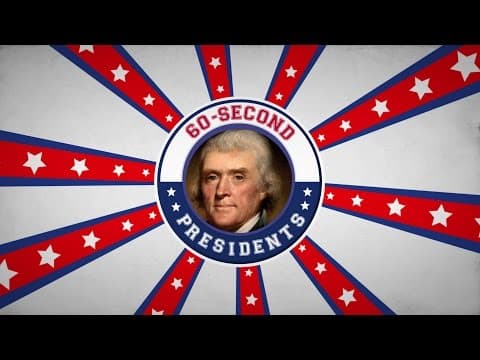
Thomas Jefferson played a pivotal role in shaping American democracy through his leadership in the Declaration of Independence and his presidency, where he sought to reduce the size of government, made the Louisiana Purchase, and faced challenges with trade policies.
Thomas Jefferson is a towering figure in American history, known for his significant contributions to the founding of the United States. His influence can be seen in two major revolutions that shaped the nation: the American Revolution and the political revolution of 1800.
In 1776, Jefferson took the lead in drafting the Declaration of Independence, a document that articulated the principles of individual liberty and the idea that power resides with the people. This foundational text not only justified the colonies' break from British rule but also laid the groundwork for the democratic ideals that would define the nation.
Fast forward to 1800, Jefferson emerged victorious in the presidential election, marking a significant shift in American politics. He believed that the national government had grown too powerful and sought to address the growing resentment among the populace. As the leader of the Democratic-Republican Party, Jefferson had the support of his allies in Congress to implement his vision.
One of Jefferson's primary goals was to reduce the size and influence of the federal government. He initiated cuts to the military, aiming to shrink the national debt, and rolled back taxes and various laws enacted by his predecessors. This approach reflected his belief in a limited government and the importance of fiscal responsibility.
In 1803, an opportunity arose that tested Jefferson's principles. France offered to sell the vast territory of Louisiana to the United States. Although the Constitution did not explicitly grant the federal government the power to acquire new land, the deal was too advantageous to pass up. Jefferson made the decision to proceed with the purchase, which significantly expanded the nation's territory.
Following the acquisition of Louisiana, Jefferson commissioned the Lewis and Clark expedition to explore the newly acquired land. This expedition not only provided valuable information about the geography and resources of the region but also demonstrated the expanding role of the federal government in exploration and development.
Despite his initial successes, Jefferson faced significant challenges during his second term. He imposed an unpopular trade embargo against England and France, which was intended to protect American interests but ultimately had detrimental effects on the economy. This decision led to widespread discontent and criticism, highlighting the complexities of governance and the limits of Jefferson's vision.
Jefferson retired from public life in 1809 and passed away on July 4, 1826, just hours after his fellow founding father, John Adams. His ideas about government and democracy continued to resonate in American politics for generations. Jefferson's legacy is a testament to the enduring struggle between the ideals of liberty and the practicalities of governance, making him a pivotal figure in the story of the United States.