The Knight's Tale, a story from Chaucer's The Canterbury Tales, explores themes of love, friendship, and chivalry through the rivalry of two knights, Arcite and Palamon, who compete for the love of Emily, leading to tragic consequences.
The Knight's Tale is a chivalric romance adapted from Giovanni Boccaccio's Teseida and is the first story in Geoffrey Chaucer's The Canterbury Tales, widely considered Chaucer's magnum opus. Composed in Middle English between 1387 and 1400, The Canterbury Tales is a collection of 24 poems narrated as part of a storytelling contest among a group of pilgrims traveling from London to Canterbury to visit the shrine of Saint Thomas Becket.
When the pilgrims draw lots to determine who will tell the first tale, the Knight is chosen. Chaucer describes him as both a storied mercenary and a modest gentleman. The principal characters in The Knight's Tale are cousins Arcite and Palamon, who sacrifice their lifelong friendship to win the hand of the beautiful Emily. Their quest for victory is marked by acts of chivalrous vainglory, ultimately leading to tragic consequences.
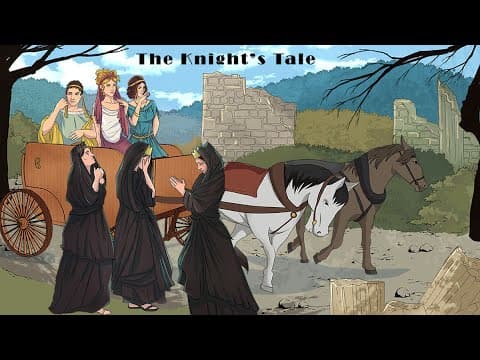
The poem opens with the story of Theseus, a duke returning to Athens after conquering the realm of the Amazons, formerly known as Scythia, and marrying Hippolyta, an Amazonian queen. On his way back, Theseus encounters a group of women clad in black near Thebes. The oldest woman begs for pity, revealing that she was once the wife of King Coponius, who was vanquished by Creon, the new ruler of Thebes. Creon refused to bury the bodies of the slain soldiers, which the women mourn.
Moved by their plight, Theseus orders his army to march towards Thebes, swearing vengeance on Creon. After defeating him, Theseus discovers two of Creon's knights, Arcite and Palamon, who are injured but alive. He sentences them to lifelong imprisonment in an Athenian tower.
Years later, while imprisoned, Arcite and Palamon spot Emily picking flowers in a garden near their tower's window. Both men immediately fall in love with her, leading to a rivalry that strains their friendship. Eventually, Arcite is freed with the help of his childhood friend, Perotheus, a duke visiting Athens. However, Theseus agrees to release Arcite only on the condition that he never returns to Athens, thus prohibiting him from courting Emily.
After spending some time in Thebes, Arcite dreams that the god Mercury instructs him to return to Athens and pursue Emily's love. Disguised as a page named Phyllis, Arcite earns the approval of Theseus, who makes him a squire of his chamber.
Meanwhile, Palamon, imprisoned for nearly seven years, decides to escape. With the help of a friend, he manages to drug his jailer and flee the tower. In a grove, he encounters Arcite, who is lamenting his life without Emily's love. Angered, Palamon confronts Arcite, and they vow to meet the next day to fight to the death for Emily.
Both knights return armed for battle, but their duel is interrupted by Theseus, Hippolyta, and Emily, who are out hunting. Upon revealing their identities, Theseus initially sentences them to death. However, Hippolyta and Emily plead for mercy, and Theseus agrees to let them compete for Emily's love in a duel, each armed with 100 knights.
The night before the duel, Palamon prays to Venus, the goddess of love, asking her to make Emily his wife. He interprets a shaking statue as an omen that she is listening. Meanwhile, Emily prays to Diana, the goddess of chastity, wishing to remain unmarried unless it is her destiny to marry someone who truly loves her. Arcite prays to Mars, the god of war, for victory in battle, and receives a whisper of victory in return.
Chaos erupts in the heavens as Mars and Venus wage war, leading to Saturn offering a compromise: Venus can help Palamon win Emily, while Mars can assist Arcite in winning the battle.
Theseus commissions a lavish stadium for the duel, and the day of the competition arrives. The knights compete valiantly, but during the battle, Palamon is accidentally wounded. Theseus declares Arcite the winner, but before he can claim Emily as his prize, an earthquake sent by Pluto frightens Arcite's horse, causing him to fall and sustain a fatal injury.
With his dying breaths, Arcite tells Emily to marry Palamon, acknowledging the chivalric code of conduct and admitting that his wounded enemy is worthy of her love. Following a heroic funeral for Arcite, Emily indeed marries Palamon, fulfilling their three prayers.
The Knight's Tale is a poignant exploration of love, friendship, and the tragic consequences of rivalry. Through the lens of chivalric ideals, Chaucer weaves a narrative that remains relevant, reflecting the complexities of human emotions and relationships.