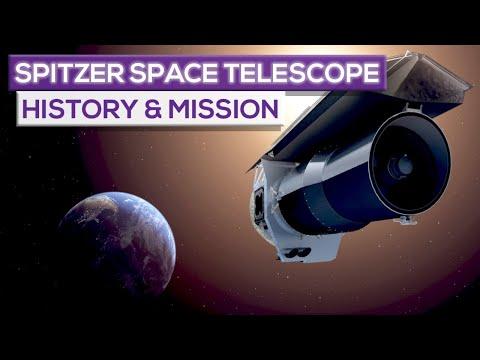
The Spitzer Space Telescope, launched in 2003 and retired in 2020, was a pivotal instrument in NASA's Great Observatories Program. It made groundbreaking discoveries in infrared astronomy, revealing insights into star formation, exoplanets, and the structure of the Milky Way, significantly advancing our understanding of the universe.
From its construction to its mission and the discoveries it made, the Spitzer Space Telescope has left an indelible mark on the field of astronomy. This blog post delves into the history and mission of Spitzer, highlighting its contributions to our understanding of the universe.
Understanding the cosmos from Earth has its limitations. Astronomers have long relied on telescopes to study the solar system, our galaxy, and beyond. However, ground-based telescopes cannot capture all the data available in the universe. To overcome these limitations, NASA and other space agencies developed space telescopes, with the Spitzer Space Telescope being one of the most notable.
The Spitzer Space Telescope was the final mission in NASA's Great Observatories Program, which included the Hubble Space Telescope, Compton Gamma-Ray Observatory, and Chandra X-Ray Observatory. Launched in 2003, Spitzer was designed to observe the universe in infrared light, primarily detecting heat radiation. It was officially retired on January 30, 2020.
Spitzer consisted of two major components:
Spitzer was equipped with three key scientific instruments:
These instruments enabled Spitzer to explore regions of space obscured from optical telescopes, such as dusty stellar nurseries and the centers of galaxies.
Originally designed for a minimum operational life of 2.5 years, Spitzer exceeded expectations, functioning for over 17 years. After its coolant was depleted in 2009, it transitioned to a "warm mission," continuing to provide valuable data until its retirement in 2020.
Spitzer made numerous groundbreaking discoveries during its mission:
The Spitzer Space Telescope has significantly advanced our understanding of the universe, from mapping the Milky Way to discovering new planets and studying star formation. Its legacy is a testament to the power of infrared astronomy and the importance of space exploration. As we look to the future, Spitzer's achievements set a high bar for the next generation of space telescopes. The mission may have ended, but the knowledge gained will continue to influence astronomical research for years to come.