This blog post explores the fraudulent claims made by Ron Wyatt regarding the discovery of Noah's Ark. It details the initial findings, the involvement of various experts, and the eventual debunking of Wyatt's assertions through scientific analysis and geological evidence, revealing the truth behind the so-called Ark.
The story of Noah's Ark has captivated the imaginations of many, but one of the most outrageous claims regarding its existence comes from Ron Wyatt, a nurse anesthetist from Tennessee. Wyatt convinced millions that he had discovered the actual remains of Noah's Ark, leading to a saga filled with fraud and deception. This blog post delves into the details of Wyatt's claims, the experts he enlisted, and the scientific investigations that ultimately debunked his assertions.
In 1959, a Turkish army captain named Ilhan Dupinar discovered a boat-shaped formation in eastern Turkey while studying aerial photographs for a NATO mapping project. This intriguing find was featured in Life magazine in 1960 as a potential candidate for Noah's Ark. However, initial surveys by a joint Turkish and American team concluded that the formation was likely a natural geological structure, effectively closing the case.
Despite the scientific consensus, Ron Wyatt, who had no formal training in archaeology or geology, claimed that God had revealed to him that this formation was indeed Noah's Ark. To bolster his credibility, Wyatt recruited notable figures, including astronaut Jim Irwin, who had walked on the moon and was also searching for the Ark. With Irwin's involvement, Wyatt's claims gained traction.
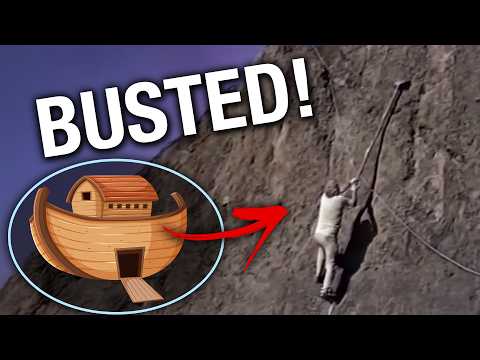
In August 1984, Wyatt and Irwin arrived at the site equipped with metal detectors. They reported finding metal readings that Wyatt interpreted as evidence of the Ark's structure, claiming to see petrified remains of the ship. They collected samples that were later confirmed to contain man-made metal, further fueling Wyatt's narrative.
Wyatt continued to expand his team, bringing in experts like John Bombgardner, a geophysicist, and Dave Feld, a marine salvage expert. They employed various technologies, including a molecular frequency generator, to map the site. However, the methods used were questionable, and the results were far from conclusive.
Despite the initial excitement, several significant issues arose:
The molecular frequency generator used by Feld was essentially a pseudoscientific device resembling dousing rods, which had been debunked for decades. Additionally, the metal detectors employed were outdated and poorly suited for the mineral-rich soil of the site, leading to false positives.
Wyatt's team attempted to use ground penetrating radar (GPR) without proper permits and in a rushed manner. The equipment used was primitive and incapable of providing accurate readings in the challenging geological conditions of the area. Subsequent analyses revealed no evidence of a man-made structure, contradicting Wyatt's claims.
In 1987, a qualified team, including Dr. Bombgardner and Turkish geologist Dr. Sali Baktutan, conducted a thorough investigation of the site using advanced technology and systematic methods. Their findings confirmed that the formation was a natural geological structure, not a remnant of Noah's Ark.
The Durupinar site is identified as a doubly plunging syncline, a natural formation resulting from tectonic forces. Similar formations exist worldwide, demonstrating that the boat-shaped appearance is purely coincidental and not indicative of human construction.
Despite the overwhelming evidence against him, Wyatt continued to promote his findings, misrepresenting the results of his experts and using their names to lend credibility to his claims. Even after being debunked, Wyatt's organization persisted in disseminating false information.
Experts like Dr. Bombgardner and Dave Feld eventually distanced themselves from Wyatt. Bombgardner publicly denounced Wyatt's claims, stating that they were fraudulent. Feld, after years of belief, also came to realize the truth, ultimately canceling his book on the subject and forfeiting potential royalties.
Ron Wyatt's claims about discovering Noah's Ark are a cautionary tale about the dangers of confirmation bias and pseudoscience. His lack of scientific rigor, combined with a desire to validate a predetermined belief, led to a series of fraudulent assertions that continue to mislead people today. The Durupinar site is not Noah's Ark; it is a natural geological formation, and Wyatt's legacy serves as a reminder of the importance of scientific integrity in archaeology.
The story of Ron Wyatt and his claims about Noah's Ark highlights the need for critical thinking and skepticism in the face of extraordinary claims. As we continue to explore our world and its history, let us remain vigilant against deception and strive for truth based on evidence and scientific inquiry.