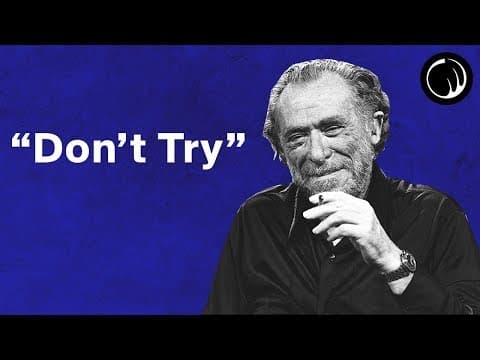
Charles Bukowski's life and philosophy emphasize the importance of authenticity in creative pursuits, suggesting that true passion should flow naturally rather than be forced. His gravestone's inscription, 'Don't Try,' encapsulates his belief that genuine creativity arises from being true to oneself, rather than striving for external validation or success.
Charles Bukowski was a 20th-century American writer and poet known for his unfiltered, potent, and often crude takes on life. Born in Germany in 1920, Bukowski emigrated with his family to America in 1923. His childhood was marked by hardship, as he faced regular beatings from his father starting at age six. As an immigrant, he was ridiculed by peers for his accent and clothing, leading to a sense of isolation throughout his schooling.
During his teenage years, Bukowski developed a severe case of acne, which further intensified his self-consciousness and feelings of alienation. These early experiences of abuse and loneliness shaped his perspective on life and fueled his desire to express himself through writing. In a later interview, Bukowski reflected on his father's influence, stating that he was a great literary teacher because he taught him about pain, specifically "pain without reason." He noted, "When you get the shit kicked out of you long enough... you will have a tendency to say what you really mean."
In his 20s, after two years of college, Bukowski quit school to pursue writing full-time. He traveled across the United States, taking on various blue-collar jobs while writing hundreds of short stories. However, only a few of these stories were published, and those that were met with little success. Disheartened by the publishing process, Bukowski stopped writing altogether for several years, returning to various blue-collar jobs.
In 1955, at the age of 35, Bukowski faced a life-threatening situation when he nearly died from a bleeding ulcer. Surviving this ordeal prompted him to quit his job at the post office and return to writing. Despite publishing several pieces in the following years, he still struggled to find success and was forced to return to the post office. This time, however, he continued to write before his shifts, dedicating whatever time he had to his craft.
For years, Bukowski wrote daily, contributing to underground magazines with little recognition. Despite the lack of success, he persisted, driven by an inner need to write. Eventually, in his 50s, after years of dedication, Bukowski's work began to gain traction, leading to a publishing deal that allowed him to make a living from his writing. His late-blooming success transformed him into a renowned figure in the literary world, celebrated for his unique voice and perspective.
Bukowski's gravestone bears the inscription "Don't Try," a phrase that seems paradoxical given his relentless pursuit of writing. How could a man who achieved success and recognition leave such a message? This inscription encapsulates a profound idea that resonates throughout Bukowski's life and work.
In a letter to fellow writer William Packard, Bukowski expressed his belief that many writers pursue their craft for the wrong reasons—seeking fame, wealth, or validation. He argued that true writing comes from a place of passion, stating, "When everything works best, it’s not because you chose writing, but because writing chose you." This sentiment reflects a broader philosophy about purpose and creativity: that genuine passion cannot be forced.
Bukowski's approach to writing was characterized by authenticity. He never compromised his voice for external approval, nor did he allow rejection to deter him from his passion. He emphasized that it is not about trying to be something one is not; rather, it is about embracing one's true self. In his letter, he advised against overexertion, suggesting that if one has to try too hard to care about something, it may not be worth pursuing.
He wrote, "We work too hard. We try too hard. Don’t try. Don’t work. It’s there. Looking right at us, aching to kick out of the closed womb." This perspective invites reflection on the nature of creativity and success. Bukowski believed that the most fulfilling creative endeavors arise when individuals are true to themselves, free from ulterior motives or excessive pressure.
While Bukowski's philosophy does not imply that creative pursuits should come easily, it suggests that the drive to create should stem from an intrinsic desire rather than external expectations. If the thought of not pursuing one's passion is more painful than the challenges faced along the way, then it is worth the effort. Bukowski's message encourages individuals to embrace their true selves and pursue their passions wholeheartedly.
In the end, Bukowski's life and work serve as a reminder that authenticity in creative endeavors is paramount. If writing, or any other passion, flows naturally and feels essential, then perhaps it is worth the effort. As Bukowski famously said, "If you’re going to try, go all the way."