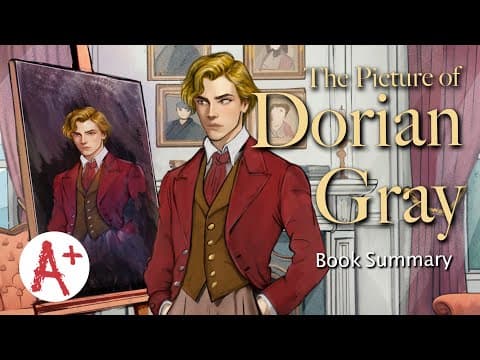
Oscar Wilde's only novel, The Picture of Dorian Gray, explores the themes of vanity, morality, and the consequences of a life devoted to hedonism through the tragic story of Dorian Gray, who trades his soul for eternal youth and beauty.
The Picture of Dorian Gray is the first and only novel written by Irish poet and playwright Oscar Wilde. This compelling story can be described as a dark fantasy, following a man who trades the purity of his soul for undying youth. The narrative delves into themes of vanity, morality, and the consequences of a life devoted to hedonism.
The story unfolds on a beautiful summer day in 19th century Victorian London. Basil Hallward, a respected and reclusive painter, entertains his aristocratic friend Lord Henry Wotton at his home. During their conversation, they admire a portrait that Basil is working on, which features a handsome and charming young man named Dorian Gray.
Lord Henry insists on meeting Basil's muse, but Basil is reluctant, hoping to shield the innocent boy from Lord Henry's cynical worldview. However, Dorian arrives unexpectedly, and upon their introduction, Lord Henry is immediately captivated by Dorian's charm and good looks.
Lord Henry, known for his persuasive opinions, begins to discuss the fleeting nature of beauty with Dorian. Horrified by the idea that his beauty will eventually fade, Dorian expresses a desperate wish: he would give his soul to remain young while his portrait ages. Shocked by this reaction, Basil attempts to destroy the painting, but Dorian stops him, declaring that such an act would be murder. Basil ultimately decides to gift Dorian the portrait.
A month later, Dorian visits Lord Henry to share news of his love for an outstanding actress named Sibyl Vane, who performs in Shakespearean plays. Despite Dorian's upper-class status, Sibyl's family is hesitant about the engagement due to their financial struggles. Sibyl's brother, James, is particularly suspicious of Dorian's intentions and vows to protect his sister.
Dorian invites Lord Henry and Basil to watch Sibyl perform in Romeo and Juliet. To everyone's surprise, Sibyl performs poorly, leading to Dorian's embarrassment. After the performance, Dorian confronts Sibyl, who explains that her love for him has made her unable to act. Dorian reacts coldly, and upon returning home, he notices that Basil's portrait now bears a hint of cruelty in Dorian's expression.
The following day, Lord Henry visits Dorian, only to inform him that Sibyl has committed suicide after their fight. Lord Henry advises Dorian to keep a low profile to avoid suspicion. When Basil visits Dorian, he notices that Dorian seems unmoved by Sibyl's death and that the portrait has changed dramatically. Dorian, feeling invasive questions from Basil, decides to lock the painting away in the attic.
Eighteen years pass, and Dorian develops a notorious reputation in London society for his hedonistic lifestyle. After a long absence, Dorian encounters Basil again and invites him to see the portrait. Basil is horrified to find the painting unrecognizable, reflecting Dorian's moral decay. In a fit of rage, Dorian kills Basil and enlists the help of his chemist friend, Alan Campbell, to dispose of the body. After this act, a red stain appears on Dorian's portrait, symbolizing his guilt.
Dorian seeks refuge in an opium den, where he encounters James Vane, Sibyl's brother, who recognizes him. Dorian pretends not to know Sibyl to protect himself. James, however, vows to avenge his sister's death. Dorian narrowly escapes, but James begins to stalk him. After a few days of hiding, Dorian joins Lord Henry on a hunting trip, where James is accidentally killed, relieving Dorian of his immediate threat.
In the months that follow, Dorian attempts to change his ways, reflecting on the lives he has ruined, including Sibyl, Basil, and James. He tries to treat a young lady he is courting with respect, hoping to redeem himself. However, when he looks at Basil's portrait, he finds it even more grotesque, haunted by his past actions.
Desperate to escape his guilt, Dorian takes a knife and stabs the portrait, hoping to destroy the evidence of his sins. His servants are awakened by a dreadful scream and discover a disfigured body on the floor, resembling the last version of Basil's portrait. The body is identified as Dorian Gray, only recognized by the rings on his fingers, while the portrait remains young and beautiful, reflecting the innocence Dorian once had.
The Picture of Dorian Gray serves as a cautionary tale about the dangers of vanity and the moral consequences of a life lived without regard for others. Oscar Wilde's exploration of beauty, corruption, and the quest for eternal youth resonates deeply, reminding readers of the inevitable decay that comes with a life devoid of virtue.