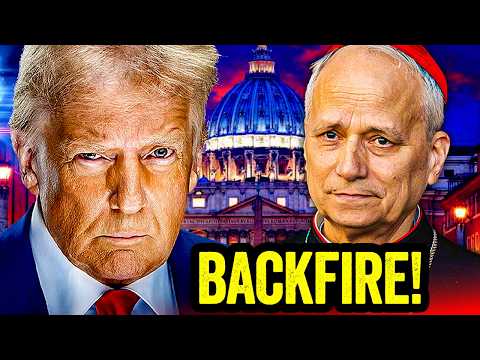
Pope Leo XIV initially criticized President Trump, calling him a tyrant, which the media celebrated as a moral stand. However, after Trump's strong rebuttal, the Pope quickly retracted his stance and even advised African students to stay in their countries rather than immigrate. This unexpected reversal highlights the Vatican's complex political positioning and the rise of theopolitics, with the Pope's influence being challenged by American Catholic conservatives.
Recently, Pope Leo XIV, the first American pope in 2000 years of Church history, made headlines by initially criticizing President Donald J. Trump, labeling him a tyrant in all but name. This bold stance was widely celebrated by the international media and the political left as a moral rebuke against Trump. However, the situation took an unexpected turn when the Pope quickly walked back his comments following a strong pushback from Trump himself.
On April 12th, shortly after meeting with former Obama strategist David Axelrod, Pope Leo XIV declared that the world was being devastated by a handful of tyrants. The international press immediately interpreted this as a direct shot at President Trump, particularly criticizing his Iran policy. The Pope doubled down on his remarks in Alers and Cameroon, openly stating he had no fear of the Trump administration.
The media frenzy was intense. Outlets like Rolling Stone, CNN, and USA Today portrayed the Pope as a fearless moral authority standing up to Trump, even suggesting that his feud was dividing American Catholics. The globalist left hailed the Pope as their new champion, continuing a trend of liberal-leaning popes. Even comedian Bill Maher expressed surprise at how the Democrats and media had embraced the papacy as an unlikely hero.
True to his style, President Trump responded firmly and publicly. He took to True Social to call the Pope weak on crime and terrible on foreign policy, stating plainly, "I don't want a pope who critiques the president of the United States."
Trump also exposed the Pope's social media account's left-wing activist leanings by reposting now-deleted retweets and approvals, revealing a political bias within the Vatican's communications.
Within days, the Pope appeared to backtrack. Speaking aboard the papal plane from Cameroon to Angola, he clarified that much of what had been written was commentary on commentary, and that his recent speech had been prepared weeks before any comments from the President. This was a clear sign of standing down from his earlier confrontational tone.
In a surprising move, while in Cameroon, Pope Leo XIV advised graduating students not to immigrate to other countries, such as those in Europe, but rather to stay in their own nations and work to improve them. This stance directly contradicts his previous criticisms of the Trump administration's border security policies and shocked the political left.
This message suggests a significant shift in the Pope's approach, advocating for respect of national borders and encouraging local development over migration.
Vice President JD Vance, a devout Catholic, responded graciously to the Pope's retreat, emphasizing the complexity of the situation and praising the Pope for preaching the gospel and offering moral opinions on contemporary issues.
Historically, the Vatican has maintained a posture of permanent neutrality, positioning itself as a peaceful sovereign and moral conscience above political frays. This neutrality was formalized in the Lateran Pacts of 1929.
However, recent analyses, such as one from the Cardinal Vanthuan Observatory for the Social Doctrine of the Church, argue that the Vatican's neutrality is a fiction. The institution has increasingly aligned with far-left, elitist, and globalist agendas, often opposing nationalism, populism, and conservative figures like Trump.
The Vatican consistently champions left-wing causes, including open borders, global governance, and radical climate alarmism, aligning closely with organizations like the World Economic Forum, the European Commission, and the World Health Organization.
A significant global trend is the rise of theopolitics—the reemergence of religion as a central force in domestic and international politics. This is evident in conflicts such as those in the Persian Gulf and in alliances like the Abraham Accords.
The progressive wing of the Catholic Church, dominant since Vatican II, understands that Catholic voters in key states like Pennsylvania, Michigan, and Wisconsin are crucial to the American political landscape. The Pope's initial attempt to sway these voters away from Trump reflects this understanding.
However, the Pope's quick retreat and his new stance on immigration indicate that this strategy did not succeed. The American Catholic laity, from leaders like JD Vance to millions of faithful, have shown resistance to top-down progressive papal politics.
Pope Leo XIV's recent actions reveal a complex and evolving relationship between the Vatican and American politics. His initial confrontation with President Trump, followed by a swift retreat and a surprising message on immigration, underscores the challenges the Church faces in maintaining its moral authority amid global political pressures.
The episode highlights the growing influence of theopolitics and the struggle within the Catholic Church between progressive and conservative forces. As this dynamic unfolds, figures like President Trump remain ready to challenge the Vatican's political maneuvers, signaling that the era of progressive papal politics may be facing significant pushback.
This ongoing saga will undoubtedly continue to shape the intersection of religion and politics in the years to come.