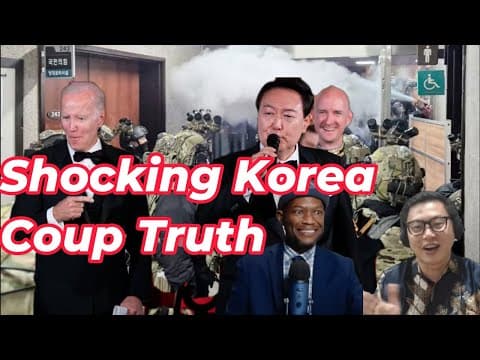
The recent coup attempt in South Korea reveals a complex web of political maneuvering, military involvement, and international relations, particularly with the United States. The situation escalated when the South Korean president attempted to declare martial law, allegedly to suppress opposition and maintain control, leading to significant public backlash and a failed coup.
The political landscape in South Korea has recently been shaken by a shocking coup attempt that has drawn international attention. This blog post delves into the details surrounding the coup, the motivations behind it, and the implications for South Korea's democracy and its relationship with the United States.
The situation escalated dramatically when the former South Korean Defense Minister attempted to take his own life upon realizing he would be arrested. This incident highlighted the gravity of the political crisis, as the president's office was raided and the president himself was forbidden from leaving the country. The president, who had enacted a temporary dictatorship, justified his actions by claiming that the opposition was backed by North Korea, thus necessitating extreme measures to preserve democracy.
The coup's initial plan involved creating a military emergency on the Korean Peninsula to justify declaring martial law. This included provocative actions aimed at North Korea, such as flying military aircraft over Pyongyang to distribute propaganda flyers. However, North Korea did not respond as anticipated, forcing the South Korean military to pivot to a direct declaration of martial law.
There are strong indications that the United States was aware of the coup plans, given the bilateral treaty that grants the U.S. operational control over South Korean military forces during wartime. The lack of condemnation from Western leaders during the coup attempt raises questions about the U.S.'s role and whether they were complicit or simply informed about the unfolding events.
As the coup unfolded, South Korean lawmakers took swift action to prevent the president from consolidating power. Despite the president's attempts to block parliamentary sessions, lawmakers climbed over fences to convene and challenge the martial law declaration. Their determination showcased a commitment to democracy and the rule of law, even in the face of military intimidation.
The coup attempt has revealed the president's unpopularity, with approval ratings plummeting. Many South Koreans are frustrated with the government's alignment with U.S. interests, particularly regarding military alliances with Japan, which many view as a historical adversary. The opposition leader's comments about non-involvement in the Taiwan Strait issue further fueled tensions, as they were perceived as a threat to U.S. strategic interests in the region.
Following the failed coup, the South Korean parliament has been investigating the president's actions. Although an impeachment vote failed, public scrutiny remains high, and lawmakers are under pressure to hold the president accountable. The situation has raised concerns about the future of democracy in South Korea and the potential for further political instability.
The recent coup attempt in South Korea serves as a stark reminder of the fragility of democracy in the face of political ambition and external pressures. As the situation continues to evolve, it is crucial for both South Koreans and the international community to remain vigilant in defending democratic principles and ensuring that the voices of the people are heard. The implications of this coup extend beyond South Korea, affecting regional stability and U.S. foreign policy in East Asia.