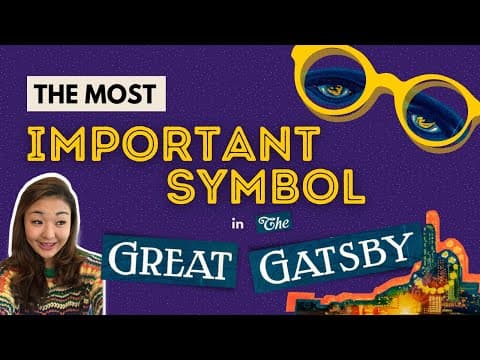
This blog post explores the significance of Dr. T.J. Eckleburg's eyes in F. Scott Fitzgerald's The Great Gatsby, analyzing their representation of moral oversight, the critique of social class, and the spiritual emptiness of the Jazz Age.
In F. Scott Fitzgerald's classic novel, The Great Gatsby, one of the most important symbols is the eyes of Dr. T.J. Eckleburg. This blog post delves into the meaning and implications of this symbol, examining its role in the narrative and its broader commentary on society during the 1920s.
Dr. T.J. Eckleburg's eyes are depicted as part of a dilapidated billboard overlooking the motor highway between West Egg and New York City. Originally an advertisement for an oculus clinic in Queens, the eyes are described as blue and gigantic, with retinas that are one yard high, set within enormous yellow spectacles. This striking imagery sets the stage for a deeper exploration of their significance.
The positioning of the eyes is crucial to understanding their symbolism. They are located between West Egg, where characters like Gatsby and Nick Carraway reside, and the bustling commercial hub of Manhattan. Notably, East Egg, home to the old money elite like Tom and Daisy Buchanan, lies outside the gaze of Dr. Eckleburg. This selective oversight raises questions about the nature of the eyes as a symbol of divine judgment. Critics have suggested that they represent a god-like figure observing humanity's sins, yet they seem to ignore the moral failings of the wealthy elite.
The eyes of Dr. T.J. Eckleburg are described as lacking a face, which gives them a non-human, god-like quality. However, the need for spectacles implies a flawed vision, suggesting that this supposed god is not omniscient. The gradual fading of the billboard's paint symbolizes the diminishing power of this moral oversight, reflecting the spiritual decay and moral apathy of the era.
The first encounter with Dr. Eckleburg's eyes occurs in Chapter Two, where they loom over a desolate landscape. This moment introduces the idea of a morally compromised god, as Tom Buchanan, who is engaged in an affair, exchanges a knowing frown with the eyes. This interaction highlights the irony of a god who observes but does not intervene in human sinfulness.
The eyes reappear in Chapter Seven, during a pivotal moment when Myrtle Wilson is killed by Gatsby's car. The faded eyes serve as a foreboding presence, hinting at the impending tragedy. Their faded state reinforces the notion of a god who is aware yet powerless to prevent human suffering. The juxtaposition of the eyes with Myrtle's intense gaze emphasizes the futility of both perspectives, as neither can avert disaster.
In Chapter Eight, after Myrtle's death, George Wilson fixates on the eyes of Dr. T.J. Eckleburg, believing them to be a representation of divine oversight. However, Michaelis, a witness, points out that they are merely an advertisement, stripping away the illusion of godliness. This revelation underscores the emptiness of the symbol, as it becomes clear that Dr. Eckleburg's eyes do not offer any moral or spiritual guidance.
Ultimately, the eyes of Dr. T.J. Eckleburg symbolize the godlessness and moral decay of the Jazz Age. They serve as a reminder of the emptiness that pervades the lives of the characters in The Great Gatsby, reflecting Fitzgerald's critique of a society obsessed with wealth and status, yet devoid of true meaning or redemption. The eyes stand as a haunting reminder of the consequences of a life lived without moral compass, encapsulating the novel's central themes of disillusionment and despair.
This analysis of Dr. T.J. Eckleburg's eyes invites readers to reflect on their significance and the broader implications for understanding The Great Gatsby as a critique of American society in the 1920s.
Feel free to share your thoughts on this symbol and its interpretations in the comments below.