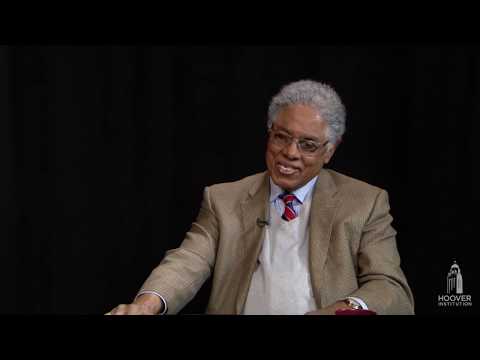
In a discussion with Peter Robinson, Thomas Sowell explores the roots of economic disparities, challenging the prevailing notions of discrimination and genetic determinism. He argues that historical and social factors, rather than inherent biases or genetics, shape economic outcomes, emphasizing the importance of individual merit and the dangers of government intervention in wealth redistribution.
Welcome to Uncommon Knowledge. In this episode, Peter Robinson interviews Thomas Sowell, a renowned economist and author, who has taught at prestigious institutions such as Cornell, UCLA, and Amherst. Sowell, now a senior fellow at the Hoover Institution, discusses his latest book, a revised edition of "Discrimination and Disparities," which critiques the common belief that economic disparities are primarily due to discrimination or genetic factors.
Sowell begins by addressing the idea that if economic benefits are not solely due to individual merit, it justifies government intervention to redistribute wealth. He argues against this notion, stating that simply transferring wealth from the rich to the poor does not address the underlying issues. He presents an extreme example of an individual who inherits wealth without merit, questioning what politicians would do with such an empire. Sowell asserts that the marketplace naturally reallocates resources to those who can manage them effectively, rather than politicians.
Sowell traces the historical explanations for economic disparities, noting that early 20th-century intellectuals attributed socio-economic differences to genetics and race. By the mid-20th century, the narrative shifted to discrimination as the primary cause. However, Sowell points out that even proponents of genetic explanations, like Arthur Jensen, eventually rejected the idea of an IQ ceiling for certain groups, indicating that the scientific basis for these arguments was flawed.
Sowell emphasizes that disparities often arise from factors unrelated to discrimination or genetics. He cites studies showing that birth order and parental attention significantly impact children's development. For instance, firstborn children often achieve higher academic success than their siblings, not due to genetic superiority but because of the focused attention they receive from parents.
Sowell discusses the historical context of immigration in the United States, particularly during the 19th century. He highlights how Irish politicians represented Jewish and Italian neighborhoods, attributing this to the Irish's greater political experience. This example illustrates the complexity of socio-economic dynamics and the multitude of factors influencing group success.
Sowell provides international examples to illustrate his points. He discusses the overseas Chinese in Southeast Asia, who dominate retail and business sectors despite facing discrimination. Similarly, he notes the success of Jewish communities in Eastern Europe and Indian communities in East Africa, emphasizing that these groups often thrive despite systemic challenges.
Sowell critiques the welfare state, arguing that it has contributed to the decline of African American families and economic progress since the 1960s. He points out that prior to the Great Society initiatives, the black poverty rate was significantly lower, and family structures were more intact. The introduction of welfare programs, he argues, fostered dependency and undermined traditional family values.
Sowell contrasts two significant events in New York City: the blackouts of 1965 and 1977. During the first blackout, crime rates dropped, while the second blackout saw widespread looting and arson. He attributes this shift to changing social norms and the erosion of moral standards, suggesting that the ideas prevalent in society can significantly influence behavior.
Sowell emphasizes that access to education and the development of human capital are crucial for economic success. He argues that the focus should not be on redistributing wealth but on providing opportunities for individuals to acquire skills and knowledge. He highlights the importance of personal responsibility and the role of family structure in achieving economic mobility.
The discussion also touches on the topic of reparations. Sowell argues against the idea, stating that it is impractical and overlooks the historical context of many individuals who have no connection to slavery. He emphasizes that the focus should be on creating opportunities rather than compensating for past injustices.
In conclusion, Thomas Sowell challenges the prevailing narratives surrounding economic disparities, advocating for a focus on individual merit, education, and personal responsibility. He warns against the dangers of government intervention and the misconceptions surrounding discrimination and genetics. Sowell's insights provide a thought-provoking perspective on the complexities of socio-economic dynamics and the importance of fostering a society that values hard work and education over entitlement and dependency.





