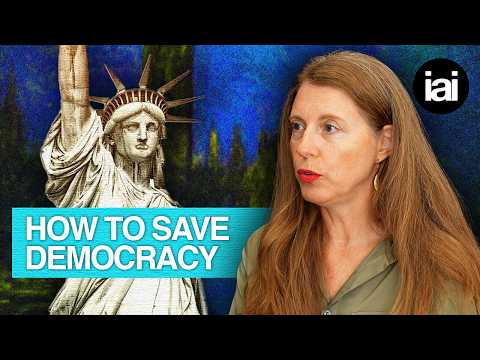
Hélène Landemore argues that the current democratic systems in the US and Europe suffer from elite stagnation and lack of inclusivity, leading to popular resentment and a drift towards autocracy. She proposes an 'open democracy' model with fewer elections and more random selection of representatives, inspired by ancient Athenian democracy, to enhance collective intelligence, deliberation, and representation of diverse voices.
In recent years, many Western democracies have faced challenges such as political polarization, elite stagnation, and a growing popular resentment that sometimes channels into support for authoritarian figures. Political theorist Hélène Landemore offers a compelling diagnosis and a bold solution: to save democracy, we need more democracy in terms of inclusivity and deliberation, but fewer traditional elections.
Landemore identifies a concentration of power and a stagnation of elites in Western democracies, particularly in the US and Europe. These elites often remain in power for extended periods, becoming professionalized and disconnected from the concerns of ordinary citizens. This disconnect has led to policies that neglect or harm working-class populations, such as rapid globalization without adequate compensation for those adversely affected.
She cites examples like the fuel tax in France, which sparked the Yellow Vests movement, as evidence of systemic dysfunction. This popular resentment, while justified, is often misdirected towards authoritarian solutions that promise efficiency but ultimately undermine democratic values.
Landemore advocates for a system that amplifies the voices of ordinary people beyond the limited scope of periodic elections. She suggests complementing popular voting on issues through referenda and citizen initiatives with an alternative method for selecting representatives: sortition, or random selection.
Her ideal democratic system draws inspiration from classical Athens, where a council of 500 citizens was randomly selected to propose policies and laws. These proposals were then voted on by a larger assembly open to all citizens. Although ancient Athenian citizenship was exclusive, the principle of random selection allowed for a broad representation of voices.
Landemore calls her model "open democracy," which maximizes collective intelligence by circulating diverse views through the political system. This involves creating new chambers or "houses of the people" staffed by randomly selected citizens from all walks of life—workers, students, stay-at-home parents, and even occasional billionaires. This descriptive representation would lead to better policies with fewer blind spots.
One challenge is encouraging participation in such randomly selected bodies. Drawing from her experience with French citizens' conventions, Landemore notes that participants were compensated financially (about €84 per day) and sessions were scheduled on weekends to accommodate work commitments. Childcare was also provided to encourage women's participation.
She envisions civic duty as a segment of life, akin to attending college, where citizens dedicate time to public service, potentially supported by mechanisms like universal basic income or AI assistance.
Landemore emphasizes that politics involves defining the common good in complex, uncertain contexts. Experts alone cannot address all dimensions of issues like climate change, which intersect with social, racial, and environmental justice. Instead, experts should support a diverse deliberative body that brings together varied lived experiences to make informed decisions.
Critics argue that such a system might slow decision-making, especially compared to authoritarian regimes or even current electoral democracies. Landemore acknowledges that authoritarianism can act faster in the short term but warns that the long-term costs of mistakes and loss of legitimacy are too high.
She points to Taiwan's COVID-19 response as a model of rapid yet democratic and transparent decision-making. Moreover, she distinguishes between democratic inclusivity and liberal checks and balances, suggesting that excessive counter-majoritarian barriers in systems like the US contribute more to inefficiency than democracy itself.
A concern with open democracy is the potential rise of illiberal policies, as public opinion on issues like immigration or the death penalty can be restrictive. Landemore admits transitions are challenging and pendulum swings can be harsh but believes deliberation and public consultation can channel grievances productively.
Transparency and communication are key. Unlike traditional politicians who may spin or manipulate facts for re-election, randomly selected citizens have no such incentives and can be more truthful and sincere. Streaming deliberations, media coverage, and local community engagement by participants can foster public understanding and trust.
Hélène Landemore's vision for saving democracy involves rethinking representation and participation. By reducing reliance on elections and incorporating random selection and deliberation, democracies can become more inclusive, intelligent, and responsive to the diverse experiences of their citizens. While challenges remain in implementation and transition, her model offers a hopeful alternative to the current crises facing democratic governance.
This approach calls for a cultural shift in how we view civic duty and political engagement, emphasizing openness, sincerity, and collective problem-solving over professionalized politics and partisan conflict.