This blog post explores the concepts of aggregate demand and supply, focusing on their implications for economic growth, inflation, and unemployment. It explains how shifts in these curves affect the economy, detailing the causes of growth and recession, as well as the types of unemployment and inflationary pressures.
In this post, we will delve into the concepts of aggregate demand and aggregate supply, focusing on their implications for economic growth, inflation, and unemployment. Understanding these concepts is crucial for analyzing the overall health of an economy.
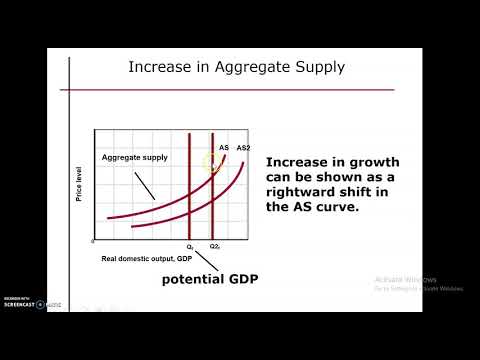
Economic growth in the long run is represented by a rightward shift in the aggregate supply curve. The aggregate supply (AS) curve reflects the total output of all suppliers in an economy and is upward sloping. It illustrates the relationship between the price level and real GDP.
Changes in aggregate supply are influenced by:
The aggregate supply curve is upward sloping, with a vertical line representing potential GDP (Qf). The point of full employment (F) indicates the economy's capacity to produce goods and services without generating inflation.
Unemployment is closely tied to the position of the aggregate supply curve. At full employment (point F), the economy experiences only the natural rate of unemployment, which includes:
When the economy is at point R, which represents a recession, it is producing less than its potential output, leading to cyclical unemployment. The gap between actual GDP during a recession and potential GDP is attributed to this type of unemployment.
Inflationary pressures can arise from shifts in the aggregate supply curve. For instance:
Similarly, inflation can also result from shifts in aggregate demand. A rightward shift in aggregate demand, caused by factors such as increased consumer confidence or government spending, will also lead to higher price levels. This shift moves the economy from point R to a new equilibrium point N, where both the price level and GDP increase.
Understanding the dynamics of aggregate demand and supply is essential for grasping the complexities of economic growth, inflation, and unemployment. By analyzing shifts in these curves, we can better comprehend the underlying factors that drive economic performance and the challenges that policymakers face in managing the economy.





