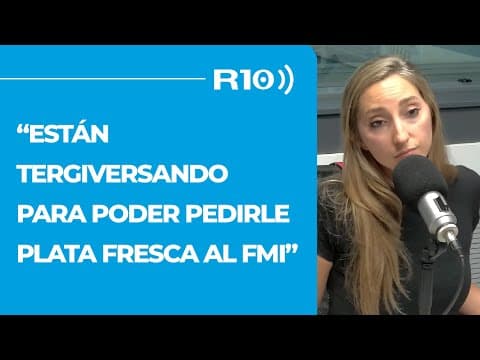
Julia Strada discusses Argentina's economic situation, focusing on the implications of recent financial maneuvers, the role of the IMF, and the need for a more comprehensive economic education to address systemic issues.
In a recent discussion on Radio 10, Julia Strada, an economist and member of the Argentine Congress, shared her insights on the current economic landscape of Argentina. With a background in political science and a master's degree in political economy, Strada provided a comprehensive analysis of the country's financial situation, particularly in relation to its dealings with the International Monetary Fund (IMF).
Julia Strada is not only a politician but also an academic with extensive knowledge in economics and political science. She has been involved in teaching at the University of Buenos Aires and the National University of Rosario, where she aims to fill the gaps in economic education that many students face. Strada emphasized the importance of understanding the complexities of Argentina's economy, which often gets oversimplified in mainstream discussions.
Strada highlighted a recent communication from the Central Bank of Argentina, which announced a repo agreement with five international banks. This maneuver, while technical, essentially involves the Central Bank taking on debt by using dollar-denominated securities as collateral. Strada explained that this was necessary to manage an impending payment of $4.7 billion due on January 9, which would significantly reduce the Central Bank's reserves.
The repo agreement is a financial operation where the Central Bank borrows money by selling securities with an agreement to repurchase them later. Strada pointed out that this is not a traditional loan but a way to manage liquidity in the face of upcoming debt obligations. The urgency of this operation raises questions about the overall health of Argentina's economy, especially given the ongoing challenges with foreign currency reserves.
Strada discussed the government's approach to dealing with the IMF, suggesting that there is a tendency to misrepresent the nature of new borrowing. The government is reportedly considering exchanging old debts with the Central Bank for new debts with the IMF, which could lead to further complications. Strada warned that this could be seen as a new form of indebtedness, which comes with its own set of conditions and challenges.
The conversation touched on Argentina's historical relationship with debt, particularly under previous administrations. Strada noted that the current government seems to be repeating past mistakes by seeking new loans without a clear plan for how to utilize the funds effectively. She emphasized that taking on debt is not inherently negative, but it must be done with a clear understanding of its purpose and potential impact on the economy.
Strada expressed concern over the lack of comprehensive economic education in Argentina. She highlighted the need for a curriculum that addresses the unique challenges faced by the country, rather than relying solely on traditional economic models that may not apply. This gap in education contributes to a misunderstanding of economic policies and their implications among both policymakers and the public.
Strada called for a more robust public discourse around economic issues, urging citizens to engage critically with the information presented by the government and the media. She believes that a better-informed public can lead to more effective economic policies and a greater accountability of those in power.
Julia Strada's insights shed light on the complexities of Argentina's economic situation, particularly in relation to its dealings with the IMF and the importance of economic education. As the country navigates its financial challenges, it is crucial for both policymakers and the public to engage in informed discussions about the implications of debt and the need for sustainable economic practices. Strada's call for a deeper understanding of these issues is a vital step towards addressing the systemic problems that have plagued Argentina for decades.