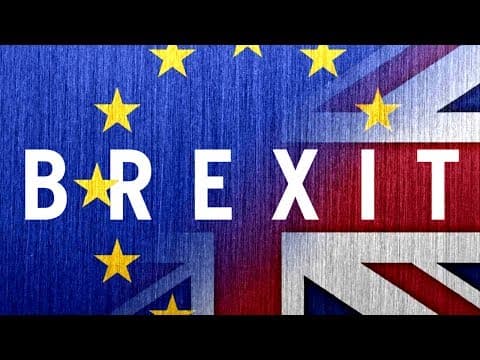
Brexit, the UK's decision to leave the EU, stemmed from historical tensions, economic considerations, and rising nationalism. The referendum held on June 23, 2016, revealed deep divisions within the country, leading to significant political and economic consequences that continue to unfold today.
On June 23rd, 2016, an entire country headed into the unknown. That’s the day 17.4 million people in the United Kingdom voted to become the first country to leave the European Union. This is the story of Brexit.
To understand Brexit, we must look back 60 years. After the devastation of World Wars I and II, a theory gained traction: stronger economic ties between countries would reduce the likelihood of conflict. In 1957, Belgium, France, Italy, Luxembourg, the Netherlands, and West Germany signed the Treaty of Rome, forming the European Economic Community (EEC). The UK was not included in this initial formation.
The UK attempted to join the EEC in 1963 and 1967 but was blocked by French President Charles de Gaulle, who cited concerns over the UK’s economy and its close ties with the United States. Eventually, after de Gaulle's departure from power, the UK became a member of the EEC in 1973.
Since its inception, the EEC evolved into the European Union (EU), expanding to 28 member states and enacting numerous laws and reforms that fostered a thriving political and economic zone for 500 million citizens. The EU was designed to mirror the successful federal structure of the United States, with member countries believing they would be better off economically and geopolitically as a unified group.
The economic performance of the EU member states, particularly the UK, Germany, and France, demonstrated this success, with GDP growth tracking closely with that of the United States. Emerging economies like Brazil, China, and South Africa highlighted the EU's effectiveness in driving growth compared to countries outside the union.
Despite the benefits of EU membership, the UK consistently sought to maintain its independence from key aspects of the union. It opted out of the open border policy established in 1995 and retained the British pound instead of adopting the Euro. The adoption of the Lisbon Treaty in 2009, which provided a formal mechanism for member states to leave the EU (Article 50), set the stage for the UK’s eventual exit.
The global recession and subsequent crises, including the Greek debt crisis and a surge in immigration from war-torn regions, fueled anti-immigrant sentiments across Europe. In the UK, Prime Minister David Cameron, facing pressure from rising nationalist sentiments and his political rivals, promised a public referendum on EU membership if he won the election. After winning, he renegotiated some terms of the UK’s membership, claiming a victory that ultimately did little to change the status quo.
The referendum scheduled for June 2016 became a pivotal moment, with the campaign heavily influenced by far-right politicians who used inflammatory rhetoric and misinformation. Key arguments for Brexit included the perception that the UK was contributing too much to the EU budget and concerns over terrorism linked to immigration.
The referendum resulted in a narrow vote of 51.9% in favor of leaving the EU, shocking the world. The immediate consequences were significant: Cameron resigned, and the value of the British pound plummeted, remaining about 15% lower against the dollar.
Theresa May, who succeeded Cameron, invoked Article 50, initiating a two-year countdown for the UK to negotiate its future relationship with the EU. Key issues to be addressed included the jurisdiction of the European Court of Justice, the rights of EU citizens in the UK, and the implications for Scotland and Northern Ireland.
The negotiations were complicated by the need for consensus among the remaining EU member states. The UK faced a challenging bargaining position, with EU leaders emphasizing the need to maintain the integrity of the union by demonstrating that leaving would have serious consequences. Business leaders in the UK expressed concerns about losing access to the EU market, which is crucial for trade.
The potential for a hard or soft Brexit became a central issue. A soft Brexit would maintain many existing arrangements, while a hard Brexit would impose tariffs and restrict immigration. The EU's leadership, particularly German Chancellor Angela Merkel, indicated that they would drive a hard bargain to protect the interests of the remaining member states.
To manage the transition, the UK government planned to pass a Great Repeal Bill, which would incorporate existing EU laws into UK law, allowing Parliament time to decide which laws to keep, amend, or discard. This uncertainty led to growing regret among some voters who initially supported Brexit, with polls indicating that many would reverse their decision if given the chance.
As discussions about the future unfolded, Lord John Kerr, the author of Article 50, noted that there is a possibility for the UK to change its mind about leaving the EU. The triggering of Article 50 is revocable, leaving the door open for potential reconsideration.
Brexit represents a complex interplay of historical, economic, and social factors that culminated in a significant political decision. As the UK navigates its post-Brexit reality, the implications of this choice will continue to unfold, raising questions about national identity, economic stability, and the future of the EU itself. What remains to be seen is whether the UK will find its independence to be as advantageous as many had hoped, or if it will come to regret its decision to leave the union.