This article explores the concept of gains from trade, highlighting how international trade can benefit all nations involved, the factors influencing these gains, and the implications for welfare distribution among different groups within countries.
In recent years, international economic issues have taken center stage as nations have become more interdependent than ever. The growth in international trade and investment has been significant, leading to episodes of trade conflict that warrant analysis. One of the key areas of focus is the concept of gains from trade, which challenges the popular belief that if one country gains through trade, another must lose.
Contrary to the zero-sum game perception, there are numerous circumstances where all countries involved in trade can mutually benefit. However, even when international trade yields positive gains, these benefits may not be evenly distributed among all parties. Thus, evaluating the gains from trade can be subjective, depending on whether we consider the perspective of individual nations or the global community.
To understand gains from trade, we must address four fundamental questions:
The theory of trade has evolved significantly over time. From the mercantilist view (1500-1880), which posited that a favorable trade balance would lead to net payments in gold and silver, to classical economists like Adam Smith and David Ricardo, who argued that trade could benefit all parties involved. Ricardo's theory of comparative advantage emphasized that specialization could lead to mutual gains from trade, focusing on cost differences rather than fixed wealth.
The gains from trade can be attributed to several factors:
Gains from trade can be assessed through two scenarios: constant opportunity cost and increasing opportunity cost.
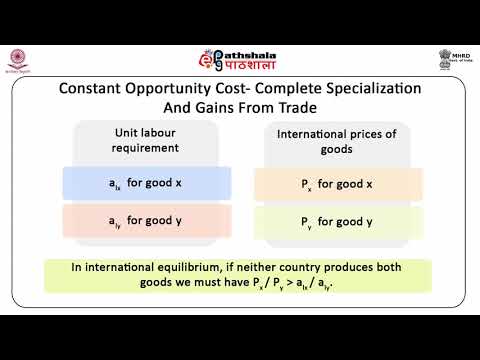
Assuming two countries, home and foreign, produce goods X and Y with constant opportunity costs, trade can lead to complete specialization. If home has a lower opportunity cost for producing X, it can trade X for Y, resulting in mutual gains. The production possibility frontiers (PPFs) illustrate how trade expands consumption possibilities, making both countries better off.
In a more realistic scenario with increasing opportunity costs, both nations may not fully specialize. As each country specializes, their opportunity costs rise, leading to a convergence of relative prices. This dynamic allows for a more nuanced understanding of how trade can still yield benefits, albeit in a less straightforward manner.
Gains from trade can be categorized into static and dynamic gains. Static gains arise from the efficient allocation of resources and specialization, while dynamic gains stem from long-term growth effects, such as increased investment, technology transfer, and improved macroeconomic policies. Dynamic gains can significantly enhance a country's growth trajectory, leading to higher income levels and investment rates.
While trade can potentially benefit all parties, the distribution of these gains can be uneven. For instance, certain groups within a country may experience losses due to trade, leading to calls for compensatory policies. The government must balance the gains and losses among different groups, considering political pressures and the needs of marginalized communities.
The exploration of gains from trade reveals a complex interplay of factors that can lead to mutual benefits for trading nations. While trade can expand economic choices and enhance welfare, it is crucial to recognize the potential for uneven distribution of gains. With appropriate policies, it is possible to address these disparities, ensuring that trade remains a source of growth and prosperity for all involved.





