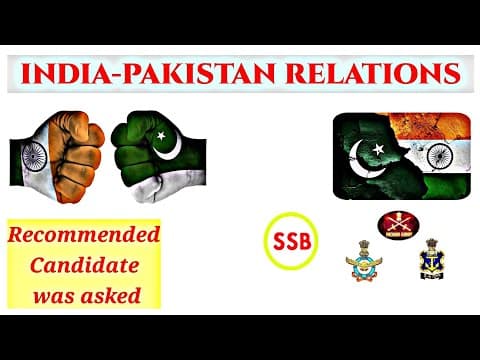
This blog post provides a detailed examination of the historical and contemporary issues surrounding India-Pakistan relations, including the partition, territorial disputes, military conflicts, and ongoing diplomatic challenges. It highlights key events, treaties, and the socio-political dynamics that shape the relationship between these two nations.
India and Pakistan share a complex and tumultuous history that has shaped their relationship since the partition of British India in 1947. This blog post aims to provide a detailed examination of the key events, issues, and dynamics that define India-Pakistan relations.
The partition of British India on August 15, 1947, led to the creation of two independent nations: India and Pakistan. This division was based on the two-nation theory, which posited that Muslims and Hindus were distinct nations deserving separate homelands. The partition resulted in significant violence, with approximately five lakh people killed and around fifteen million displaced, marking one of the largest migrations in history.
One of the most contentious issues between India and Pakistan is the status of Jammu and Kashmir. Following the partition, the princely state of Jammu and Kashmir, which had a majority Muslim population, initially chose to remain independent. However, in October 1947, tribal militias from Pakistan invaded Kashmir, prompting the Maharaja of Kashmir to seek military assistance from India. This led to the signing of the Instrument of Accession on October 26, 1947, which integrated Kashmir into India.
The first war between India and Pakistan erupted shortly after the partition over the Kashmir issue. The conflict ended in 1949 with a UN-mediated ceasefire, establishing the Line of Control (LoC) but leaving the Kashmir dispute unresolved.
The second war occurred in 1965, primarily over Kashmir. It ended with the Tashkent Agreement, mediated by the Soviet Union, but did not resolve the underlying issues.
The third major conflict, often referred to as the Bangladesh Liberation War, resulted in the creation of Bangladesh. India intervened militarily in support of the Bengali independence movement, leading to a decisive victory over Pakistan.
Following the 1971 war, the Simla Agreement was signed, emphasizing the need for peaceful resolution of disputes and reaffirming the LoC as the de facto border in Kashmir.
This treaty, brokered by the World Bank, allocated the waters of the Indus River system between India and Pakistan, aiming to prevent water disputes.
A significant aspect of the India-Pakistan relationship is the issue of cross-border terrorism. India accuses Pakistan of supporting militant groups that operate in Kashmir and other parts of India. High-profile attacks, such as the 2001 Indian Parliament attack and the 2008 Mumbai attacks, have further strained relations.
In February 2019, a suicide bombing in Pulwama killed 40 Indian paramilitary personnel, leading to heightened tensions. India conducted airstrikes in Balakot, Pakistan, targeting militant camps, which resulted in aerial skirmishes between the two nations.
The abrogation of Article 370 in August 2019, which granted special status to Jammu and Kashmir, has further complicated the relationship. Pakistan condemned the move and sought international support against India.
The relationship between India and Pakistan is marked by a history of conflict, territorial disputes, and ongoing diplomatic challenges. While there have been attempts at dialogue and peace, the underlying issues, particularly regarding Kashmir and cross-border terrorism, continue to hinder progress. Understanding this complex relationship is crucial for any discussions related to South Asian geopolitics.