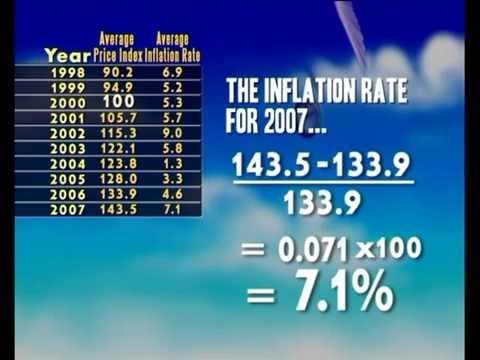
This blog post explains how to calculate the rate of inflation using the Consumer Price Index (CPI), comparing monthly and yearly figures, and discusses the implications of personal consumption patterns on perceived inflation rates.
Inflation is a critical economic indicator that affects everyone, from consumers to policymakers. Understanding how to calculate the rate of inflation can provide valuable insights into economic trends and personal finance. This post will explore the methods used to calculate inflation, specifically through the Consumer Price Index (CPI), and discuss how individual consumption patterns can influence perceived inflation rates.
Inflation refers to the rate at which the general level of prices for goods and services rises, eroding purchasing power. It is typically measured on an annual basis, allowing for comparisons over time.
The CPI is a widely used measure that tracks changes in the price level of a basket of consumer goods and services. There are two primary methods to calculate the rate of inflation using the CPI:
One straightforward method is to compare the CPI for a specific month from one year to the same month in the following year. For example, to calculate the inflation rate between December 2006 and December 2007, we can use the following CPI figures:
To find the inflation rate, we subtract the December 2006 CPI from the December 2007 CPI:
150.00 - 137.84 = 12.16
Next, we divide this result by the December 2006 CPI:
12.16 / 137.84 = 0.0881
Multiplying by 100 gives us the month-on-month inflation rate for December 2007:
0.0881 * 100 = 8.9%
A more accurate method of calculating inflation is to compare the average CPI for the entire year with that of the previous year. This approach smooths out short-term fluctuations in prices, providing a clearer picture of inflation trends. For instance, to calculate the inflation rate for the year 2007, we can use the following data:
The calculation would be:
(148.00 - 139.00) / 139.00 = 0.0647
Multiplying by 100 gives us the annual inflation rate for 2007:
0.0647 * 100 = 6.47%
While the CPI provides a general measure of inflation, it may not accurately reflect individual experiences. The inflation rate as measured by the CPI is based on a fixed basket of goods and services, which may not align with everyone's consumption habits.
Your personal inflation rate depends on the specific goods and services you regularly consume. If your spending habits differ significantly from the CPI basket, the official inflation rate may either overstate or understate your actual inflation experience. For example, if you do not spend any money on housing, which is a significant component of the CPI, the inflation rate reported may not accurately reflect your financial reality.
Understanding how to calculate the rate of inflation is essential for making informed financial decisions. By using the CPI and considering both monthly and yearly averages, individuals can gain insights into economic trends. However, it is crucial to recognize that personal consumption patterns play a significant role in determining one's actual inflation experience. By being aware of these factors, consumers can better navigate the economic landscape and make more informed choices regarding their finances.





